Plants
Retama del Teide: The White Broom That Scents the Caldera
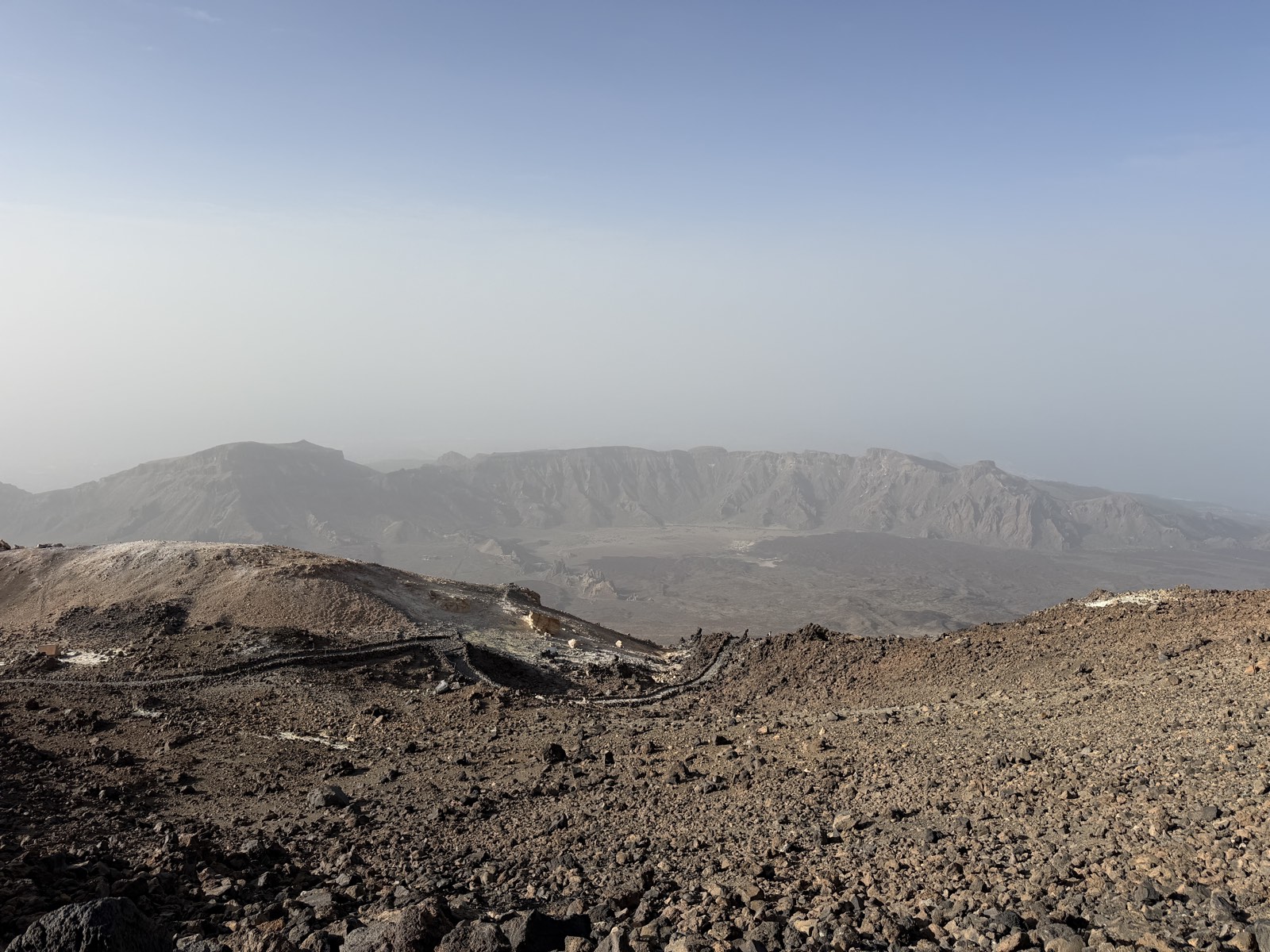
The grey-green haze that softens the lava fields of Las Cañadas is not a trick of light. It is Spartocytisus supranubius, the Teide white broom, and it is the plant that owns the ground between roughly 2,000 and 3,000 metres. From any of the caldera’s miradores, the viewpoint at El Portillo or the roadside stop at La Ruleta, what you are looking across is this one shrub, hundreds of thousands of bushes, each a dense rounded mound of fine green stems, covering the pumice and basalt as if someone had thrown a net over the mountain.
The epithet supranubius means “above the clouds”, and it earns the name. The trade-wind inversion that caps the lower slopes of Tenerife sits at about 1,500–1,800 metres, depending on the season. Above that line the air is dry, the sun is fierce and the wind has real bite. The white broom lives entirely in that exposed world. It does not creep down into the pine forest, and it does not follow the summit cone much above 3,000 metres. It is a specialist of the caldera floor and the lower slopes of the great peak itself, and it has made that barren landscape into something like a garden.
What the white broom looks like and why
At first glance the plant seems almost leafless. The stems are fine, green and photosynthetic. The leaves, where they exist, are tiny and reduced. This is not an accident. In an environment where water is scarce, ultraviolet radiation is high and the wind strips moisture from any exposed surface, a leaf is a liability. The white broom has outsourced photosynthesis to its stems and kept its leaf area to a minimum. The result is a plant that looks from a distance like a pile of green wire, but close up has a softness that is surprising. The stems are flexible, almost silky, and they carry the flowers in dense clusters that transform the whole bush in late spring and early summer.
The flowers are small pea-flowers, white to very pale pink, and they produce a scent that is one of the caldera’s defining experiences. In season, which shifts year to year but typically runs from late May into July, the air in the caldera carries a sweet, honeyed fragrance that comes and goes with the breeze. It is not subtle. Walk through a stand of broom in full flower and the smell is immediate, almost heady, and it draws bees in numbers that make the bushes hum. Local honey producers value the broom for that reason, though the honey itself is not something you can reliably buy labelled as single-source.
The ecological role: nitrogen fixation
Spartocytisus supranubius has a hidden function that matters more than its appearance. It is a legume, and like other legumes it hosts bacteria in its root nodules that fix atmospheric nitrogen into a form that other plants can use. On raw volcanic material such as pumice, ash, or broken lava, nitrogen is almost absent. Nothing grows until something puts it there. The white broom is that something.
This makes it a foundation species. It does not merely tolerate the caldera’s poor soils; it improves them. Over time, a broom bush enriches the ground around its roots, creating a microsite where other species can establish. The most dramatic beneficiary is the tajinaste rojo (Echium wildpretii), the red tower of jewels that is the caldera’s other signature plant. The tajinaste does not grow in bare pumice. It grows where the broom has already been working for years. When you see a stand of tajinaste rising from the grey-green mat of broom, you are seeing one plant standing on the shoulders of another.
The broom also stabilises the ground. The caldera floor is loose, consisting of pumice, scoria and ash that shifts underfoot and blows in the wind. The root systems of the broom bind that material, reducing erosion and keeping the surface from blowing away. Without it, the caldera would be a far more mobile, far less hospitable place.
A survival strategy for a harsh world
The high zone of Teide is not kind to plants. Rainfall is low, what falls evaporates quickly, and the temperature swings between freezing at night and strong solar heating by day. Snow falls in winter and can lie for days or weeks. Frost is common.
The white broom meets these conditions with a suite of adaptations:
- Deep roots. The roots reach far below the surface, tapping moisture that the upper layers of pumice cannot hold.
- Dormancy. In the driest or coldest periods the plant shuts down, reducing metabolic activity until conditions improve. It waits rather than trying to grow through the worst of it.
- Frost-tolerant stems. A bush that looks dead in January, grey and brittle and stripped of any green, will flush again in spring. The plant is perennial and long-lived, though exact ages are hard to determine because the stems regrow from the base. A single bush may be decades old, its root system a slow accumulation of years of nitrogen enrichment.
Threats: the mouflon problem
The white broom is not rare, but it is under pressure. The introduced mouflon, wild sheep brought to Tenerife for hunting in 1971, graze the bushes, and the damage is not just to the leaves and stems. The real problem is that mouflon and rabbits eat the seedlings. The adult population persists, but recruitment is low. In some areas the broom stands are visibly ageing, with few young plants to replace them.
This is one of the clearest arguments in the debate over mouflon control. The broom is a foundation species. If it declines, the entire high-altitude plant community, including the tajinaste, the Teide violet and the other endemics, loses its soil-maker and its stabiliser. The park authorities have culled mouflon in the past, and the controversy over that culling is sharp, but the ecological case for it rests partly on what happens to plants like this one.
When to see it
The white broom is visible year-round. The grey-green stems do not disappear in winter, but the flowering window is the time to seek it out. Late May to early July is the rough season, though it shifts with the weather. A wet spring can push flowering later; a dry one can shorten it. The scent is strongest in the middle of the day, when the sun is high and the flowers are fully open.
The best place to experience it is simply to walk into the caldera. The trail that loops around the Roques de García (Trail 3) passes through extensive broom stands. The track up to Montaña Blanca (Trail 7) crosses them at the lower end. Even the roadside pull-offs on the TF-21 between El Portillo and the cable car base station offer good views of the broom in flower, though the scent is stronger away from the traffic.
For