Plants
Echium wildpretii: The Botany of the Tower of Jewels
Of the many plants that persist on the high slopes of Teide, none announces itself with as much decisiveness as Echium wildpretii. For most of its life it is a low, unremarkable rosette of silvery leaves, hugging the volcanic gravel. Then, in a single surge, it pushes up a spike that can reach three metres tall, packed with hundreds of crimson flowers. After setting seed, the whole plant dies. The spectacle is brief, but the botany behind it is a story of island evolution, extreme adaptation, and a life history strategy that borders on the ruthless.
Taxonomy and a namesake
Echium wildpretii belongs to the borage family, Boraginaceae, a group known for rough hairy leaves and often blue or purple flowers. The genus Echium is a varied one, found across the Mediterranean basin, Macaronesia, and parts of Africa. The Canary Islands are a particular centre of diversity, and the species that grows on Teide is one of its most distinctive.
The specific epithet honours Hermann Wildpret, a Swiss-born gardener and botanist who worked in the Orotava Valley in the nineteenth century. As the curator of the Jardín de Aclimatación de La Orotava, Wildpret played a significant role in introducing and studying the island’s flora. Naming a plant after him was fitting: he knew the high mountain vegetation as well as anyone of his time. The common name in Spanish, tajinaste rojo, links it to a local term for the tall-flowered Echium species of the islands. In English it is often called the tower of jewels, a direct allusion to the dense, gem-like inflorescence.
The monocarpic imperative
The central fact of Echium wildpretii’s biology is that it is a monocarpic perennial. This means it lives for several years as a vegetative rosette, building resources, and then flowers once and dies. The strategy is not rare in the plant kingdom – agaves do it, some lobelias do it, and a number of Echium species in the Canaries do it as well – but on Teide’s harsh slopes it makes particular sense.
Flowering demands an enormous investment. The spike is a single, unbranched stem that supports hundreds of individual fl owers, each producing nectar to attra ct pollinators. The plant must produce enough seed in that single event to compensate for the fact that it will not to get a second chance. The rosette stage can last many years; exactly how many depends on local conditions, soil, and microclimate. During that time the plant builds a deep tap root and stores carbohydrates. The decision to flower is believed to be triggered by a combination of size and seasonal cues – once the rosette reaches a certain diameter, typically after several growing seasons, it commits. There is no going back.
Adaptations to the high mountain
The leaves of Echium wildpretii are narrow and lance-shaped, and they are covered in a dense layer of silvery hairs – trichomes. These are not decorative. At altitudes above the pine belt, where the retama del Teide (Spartocytisus supranubius) forms an open scrub, the plant faces intense ultraviolet radiation, strong winds, and wide temperature swings between day and night. The trichomes reflect a portion of the UV light, reducing damage to the photosynthetic tissue beneath. They also trap a layer of humid air close to the leaf surface, cutting water loss through transpiration. This is the same principle that gives many high-altitude plants a felty or silvery appearence, from Edelweiss to the Teide violet.
The inflorescence itself is also an adaptation. The dense packing of fl owers on a single tall spike makes the plant highly visible to pollinators in a landscape where fl owering resourses are scattered and ephemeral. The colour is a deep, almost violent red, which stands out strongly againt the grey volanic rock and the white flwers of the retama. Birds, especially the Tenerife blue chafinch, are sometimes seen visiting, but the primary pollinators are insects: bees, bumblebees, and hoverflies. The nectar is copious and sugar-rich, a reward that attracts visitors over long distances.
Pollination and the role of bees
The flwers of Echium wildpretii open in sequence from the bottom of the spike upwards. This extends the total flwering period of an individual plant to about two to three weeks, giving more time for pollinators to find it. Each fl ower is tubular, with five small lobs, and the reproductiv organs are positioned so that a visiting bee must brush againt the anthers to reach the necary. Pollen adheres to the bee’s body and is carried to the next fl ower. Cross-pollination is the norm, though self-compatibility cannot be ruled out.
In the Canary Islands, the native bee Apis mellifera canariensis – a subspecies of the western honeybee – is an importnt pollinator across the archipelago. It is active on the mountains during the fl owering season, which typically falls in late spring and early summer, though the exact timing shifts with altitude and year-to-year weather. The plant’s strategy: produce an enourmous amount of nectar, attract as many bees as possible, and out-compete other fl wering plants in the neighbourhood for pollinator attention. This is why a single Echium wildpretii in full fl ower can appear to hum with insect activity.
Island radiation: the many faces of Echium
The Canary Islands are home to dozens of Echium species – estimates vary, but it is certainly one of the most spectacular examples of island radiation in the Atlantic flora. The ancestor of all these species likely reached the islands from the Mediterranean region as a seed or fruit, carried by birds or ocean currants, and then diversified across the different islands and ecological zones. Each island and each habitat produced a distinct form: low-growng shrubs on the dry coasts, tall monocarpic rosette plants on the high mountains, and woody perennials in the laurisilva forests.
Echium wildpretii is the mountain specialist. Its nearest relatvies are other tall monocarpic species such as Echium pininana from La Palma and Echium virescens from Tenerife’s lower zones. The differences in fl ower colour, leaf shape, and growth form reflect adaptation to different pollinators and environmental pressures. This kind of rapid divergence, driven by isolation and selection, is what makes the Canary flora so interesting to botanists – and why Teide’s own tower of jewels is not just a beautiful object but a window into evolutionary process.
Cultivation beyond its home
The tower of jewels has been taken up by gardeners around the world, particularly in mild-temprate climates. In the British Isles, parts of New Zealand, and the Pacific Northwest of the United States, it is grown as a specimn plant in well-draind soil and full sun. It requires protection from hard frost – the high-altitude experience of the plant on Teide involves night-time tempratures that can drop close to freezing, but the snow cover is irregular, and the plant’s tolerance is not infinite. In cultivation, the rosette stage lasts two to four years, after which the fl wer spike emerges and the plant dies. It is easy to grow from seed, which germnates readily in spring, and it is a sought-after plant for the with list of collectors of unusual monocarpics.
However, cultivated specimens rarely match the drama of the wild ones. On Teide the plant grows on volcanic pumice and lapilli, lean soil with sharp drainage and a high minral content. In a garden, the spike often does not reach the full three metres, and the fl wers may be less densely packed. The wild conditions – the thin air, the direct sun, the competition – shape the plant’s expression in a way that garden soil cannot quite replicate.
The Teide violet and the mountain community
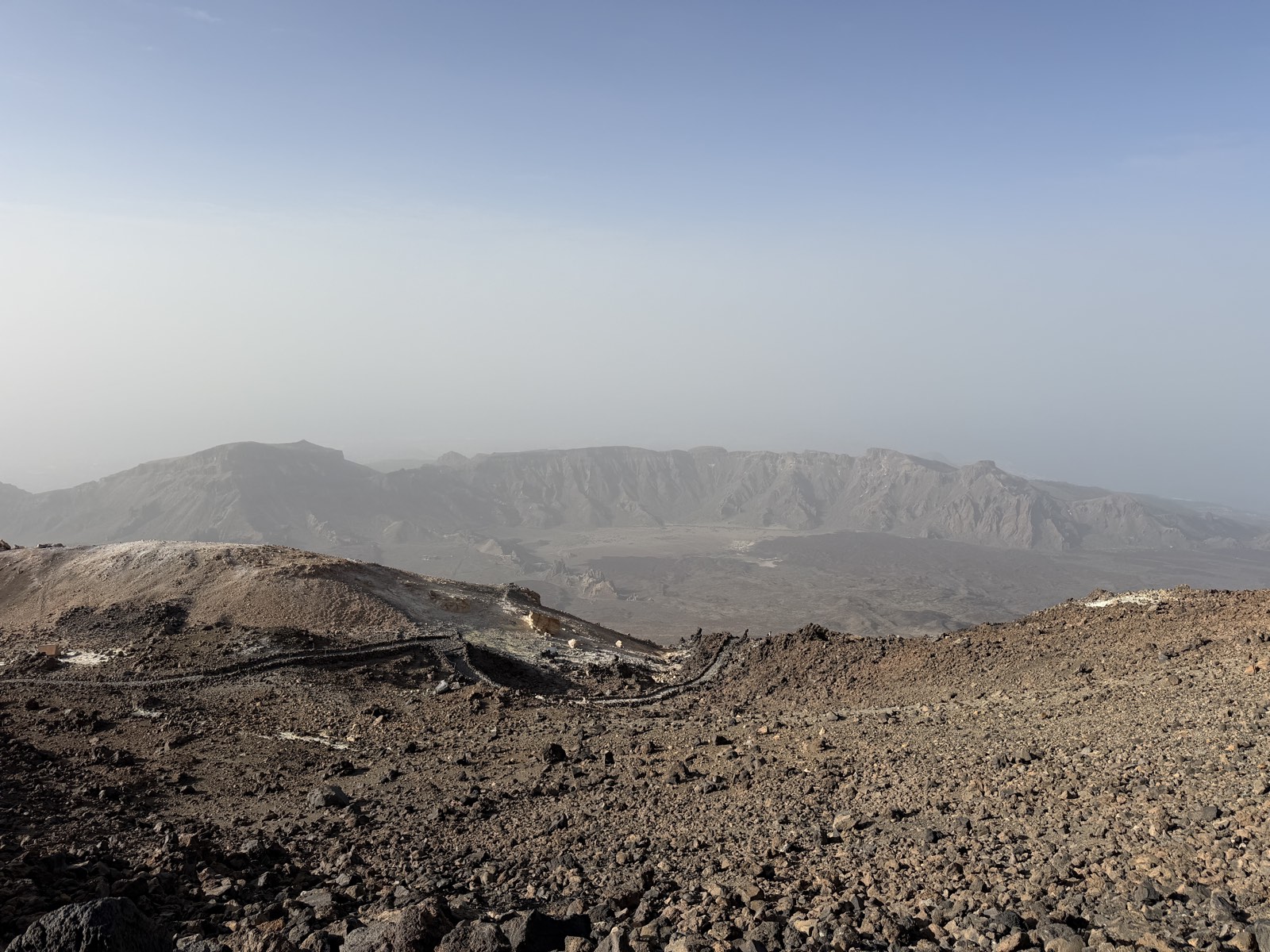
On the very summit cone of Teide, above the range of Echium wildpretii, grows the Teide violet (Viola cheiranthifolia), Spain’s highest-flowering plant. The tower of jewels does not reach that altitude. Its zone is the lower part of the high mountain, between the upper limit of the pines and the foot of the Pico Viejo and Teide cones. Here it coexists with the retama del Teide, the Teide bugloss (Echium auberianum? no – another species), and a number of endemic grasses and herbacious plants. The community is open, with bare rock and gravel between plants, and the growing season is short.
The monocarpic strategy suits this environment. By concentrating all reproductive effort into a single year, the plant avoids the need to maintain perennial stems and leaves through the harsh winter. It can survive as a low rosette, protected from the worst of the wind, and then gamble on one good season to produce seed. The risk is that a late frost or a drought could wipe out that single chanc. But on the evolutionary timescale, the gamble has paid off.
It is this tension – between the patient years of the rosette and the explosive finale – that makes Echium wildpretii a compelling plant to meet in the wild. There is no compromise in its life history. On the slopes of Teide, it does not bargain with the conditions; it waits, and then it spends everything.