Plants
The Canary Island Pine: The Tree That Survives Fire
The first thing you notice after a wildfire has passed through a Canary Island pine forest is the black. Trunks stand like charcoal pillars, the undergrowth gone, the air still carrying ash. Then you look closer. Scattered across the scorched bark are tufts of bright green needles, pushing out directly from the trunk and branches. The tree has not died. It is regrowing from its own body.
That resprouting ability is what makes Pinus canariensis exceptional among pines, and why it dominates the forest belt of Tenerife — the zone that wraps around the island between the laurel forest and the high-altitude scrub of Teide National Park. This article covers what sets the species apart: its fire biology, its role in the island’s water cycle, and the quiet history of its timber.
An endemic of the volcanic slope
The Canary Island pine grows nowhere else. It is one of the archipelago’s few conifers and forms the dominant tree cover on the middle slopes of Tenerife, La Palma, Gran Canaria and El Hierro. On Tenerife it occupies the rough band above the cloud forest of laurels and tree heathers, and below the treeless caldera where the retama del Teide scrub takes over.
The tree tolerates what would kill most others: thin volcanic soils, pumice fields, recent lava flows, and long dry seasons. Its needles are long, flexuous and drooping, growing in bundles of three — a detail that distinguishes it from the two-needled pines of mainland Europe. The cones are large and woody, holding seeds that germinate readily on bare mineral ground.
Fire as a fact of life, not a death sentence
Most pines are killed by moderate to severe fire. A few have evolved thick bark that protects the cambium, and some — notably the Mediterranean pines — rely on serotinous cones that open in heat to reseed a burned landscape. Pinus canariensis does both, but it also does something rare: it puts out new shoots from dormant buds on the trunk and main branches after the canopy has been consumed.
A fire burns through the lower branches and the needle crown. The bark, sometimes 5 cm thick or more, insulates the living tissue underneath. Within weeks, green sprouts appear along the blackened shaft. Within a few years the tree has a new crown, regrown from the same root system, on the same trunk. The tree does not have to start from seed — it survives as an individual.
This trait is shared with only a handful of pine species worldwide, most in fire-prone regions with a long, dry summer. It gives the Canary Island pine a distinct advantage in a landscape where wildfire is frequent. A forest that burns can be a forest again within a generation, without the slow process of seedling establishment and competition.
| Trait | Pinus canariensis | Typical pine species |
|---|---|---|
| Bark thickness | Very thick, insulating | Thin to moderate |
| Post-fire survival | Resprouts from trunk and branches | Usually top-killed; may reseed |
| Needle bundles | 3 needles per fascicle | 2 or 5 (common) |
| Fog combs | Yes — specialised | No |
| Native range | Canary Islands only | Varies |
The horizontal rain that waters the island
The trade winds blow from the north-east for much of the year, pushing a layer of cloud against the northern slopes of Tenerife. The pine forest sits precisely where that cloud meets the mountain. The long, clustered needles intercept the fog droplets and the water coalesces, drips, and falls to the ground.
This process, called fog combing, can add a significant fraction of annual precipitation in the pine belt — particularly during the dry summer months when rain is scarce. The effect is visible as a constant drip beneath the trees when the cloud lies low. Foresters and hydrologists speak of lluvia horizontal: horizontal rain.
The water that falls from the needles soaks into the porous volcanic soil, recharges aquifers, and feeds the streams that supply towns and agriculture lower down. The pine forest is not merely a scenic belt — it functions as a living water-harvesting system, one that the island has depended on for centuries.
Tea timber and the Canarian balcony
Pinus canariensis produces a dense, resinous wood known locally as tea (pronounced tay-ah). The heartwood is reddish-brown, rich in oils, and highly resistant to rot and insect attack. Historical builders prized it for roof beams, window frames, and the elaborate carved balconies that characterise traditional Canarian architecture.
The timber was exported to Spain and elsewhere from the 16th century onward. Much of the original forest that covered the slopes of Tenerife was felled for shipbuilding, construction, and charcoal. Replanting began in the mid-20th century, and today most of the pine forest is second-growth, though the trees still show the same resilience as their ancestors.
Walking through a stand of mature Canary Island pines, you see the evidence of age in the flaking plates of bark and the straight shafts — often branchless for many metres — that rise into a high, open crown. The wood was once the backbone of island building. It remains a quiet testament to the tree’s durability.
Above the pines: the edge of the forest
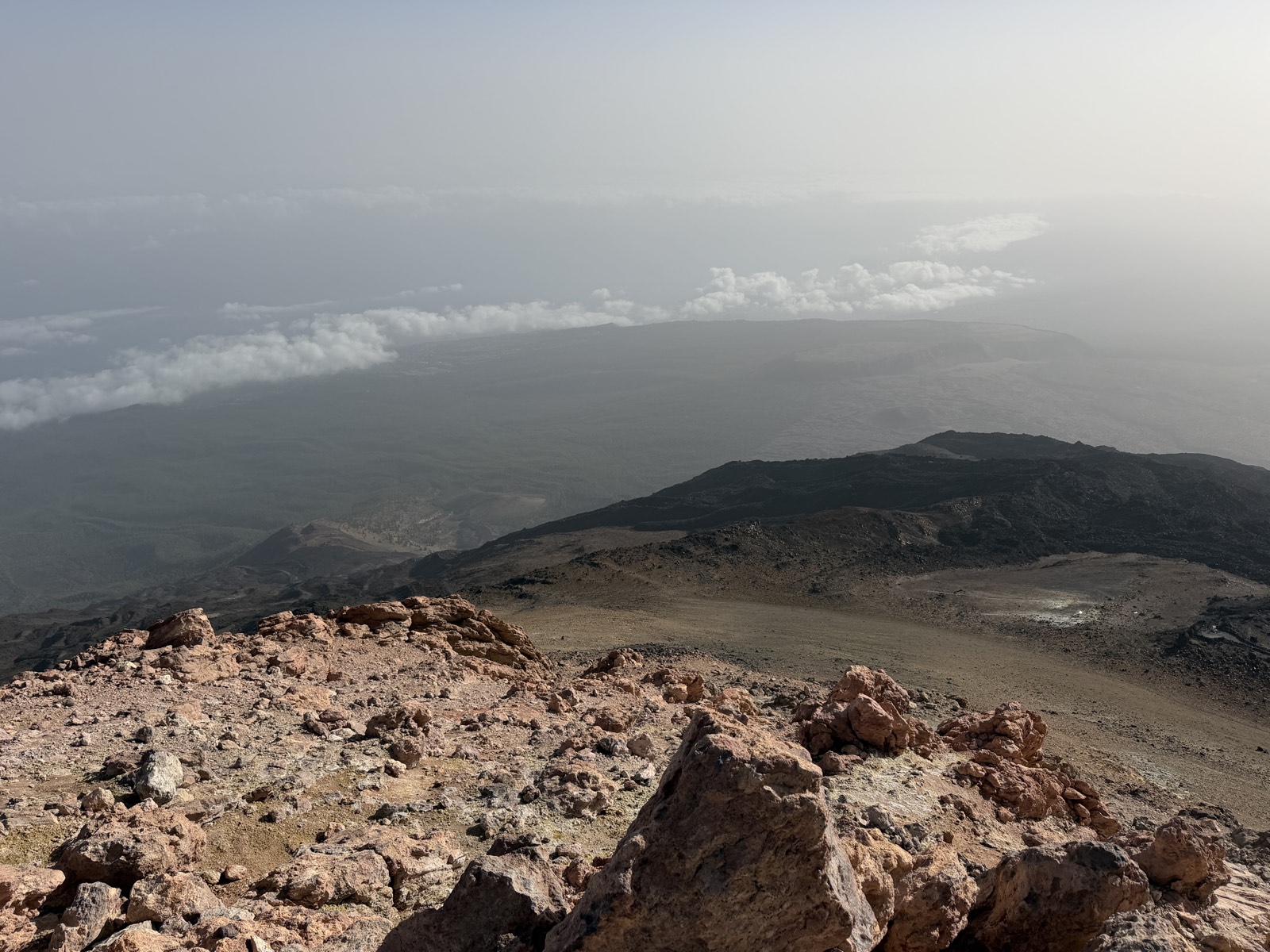
The pine belt does not extend indefinitely upward. As the slope rises and the soil thins to pumice and bare rock, the trees become stunted and eventually stop. At the transition line, scattered pines stand alone before giving way to the high-altitude scrub of the Teide caldera — a landscape of white-flowered retama bushes, Teide violets, and sprawling lava.
That upper edge is not fixed. Historical accounts suggest the forest line has shifted with climate, human use, and fire. The pines that survive at the highest elevations are the hardiest individuals, growing low and twisted against the wind.
A tree that reshapes its own landscape
Fire resistance and fog combing are not separate adaptations — they work together. The same thick bark that protects the tree from flame also slows water loss through the trunk. The same needles that intercept cloud moisture are shed in a layer that insulates the soil and reduces evaporation. The tree is both fire-survivor and water-collector, and the forest it forms modifies the microclimate around it.
In the lower reaches of the pine belt, where the laurel forest once encroached, the pines create a more open, drier environment that discourages the regeneration of competing broadleaf trees. The result is a distinct zone of Canary Island pine, self-sustained and resilient, that holds its ground against both fire and drought.
The blackened trunk that pushes out green needles is not a curiosity — it is the core of this tree’s strategy. It evolved in an island where volcanic eruptions, dry summers, and lightning fires were regular events. To survive, it had to be able to start again without starting over. And so it does, from its own charred wood, year after year.