Places & landmarks
Roque Cinchado: The Stone Tree That Was on Spain's Money
The stone tree
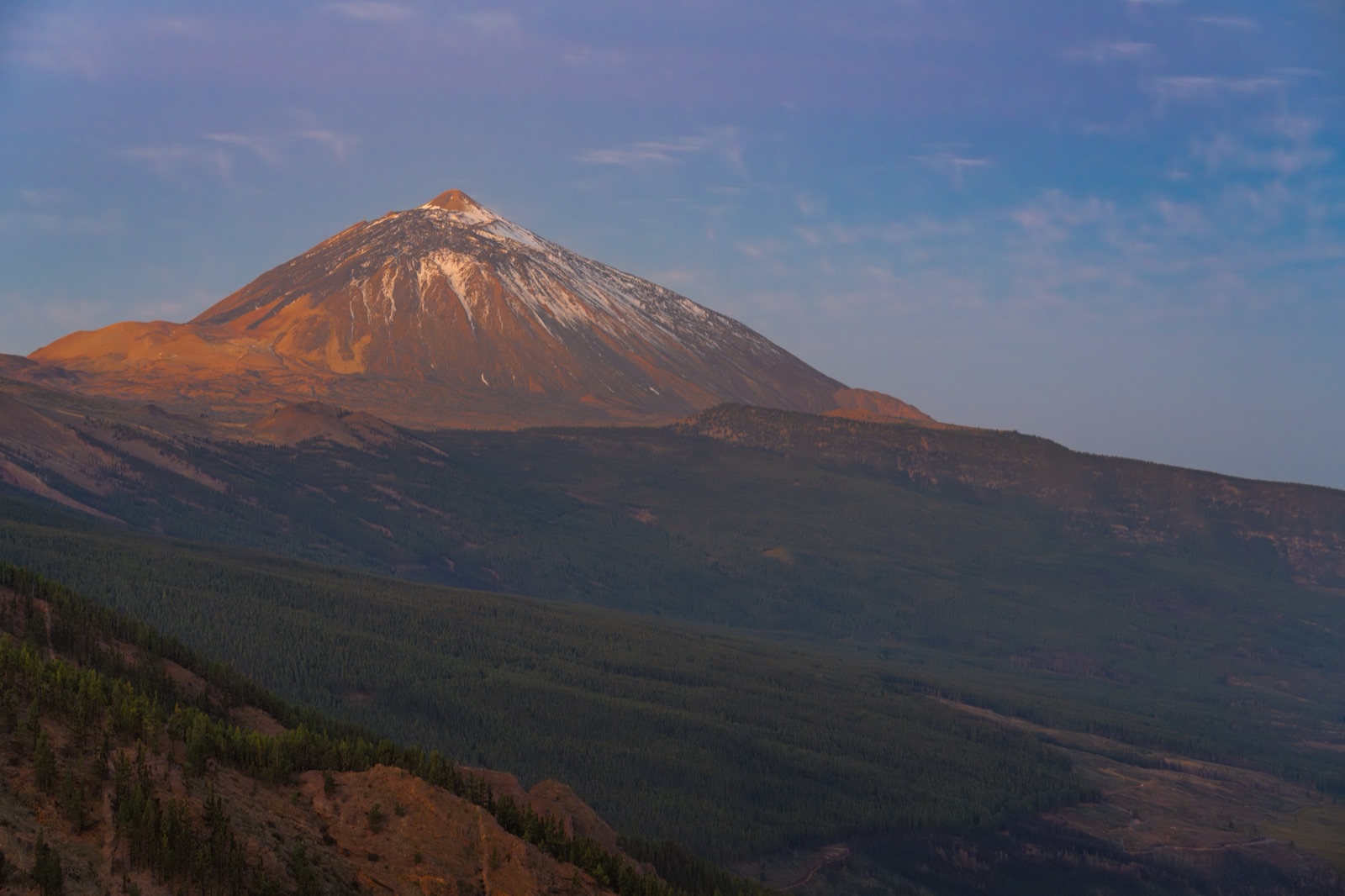
Roque Cinchado rises from the caldera floor like a weathered sentinel, its narrow waist and spread of rock at the summit earning it the name Árbol de Piedra, the stone tree. For generations of Spaniards, this odd formation was the image on the back of the 1,000-peseta banknote, Teide’s great cone rising behind it. The photograph was so deeply embedded in the country’s visual culture that even people who never climbed the mountain knew Roque Cinchado’s silhouette. It appeared on school textbooks, in government publications, and in the wallets of anyone who had saved pesetas in the twentieth century.
The rock stands within the Roques de García, a line of eroded pinnacles that cleave the floor of Las Cañadas caldera almost in two. From the Parador de Las Cañadas del Teide, the road drops down into the caldera and passes these dramatic formations. They present a wall of volcanic stone, freestanding towers and broken arches thrust up from the plain. Roque Cinchado is the most striking of them, set slightly apart from the main ridge, and it is the one that draws the camera lens.
How differential erosion shaped the pinnacle
The shape that makes Roque Cinchado so recognizable is the product of simple geology acting over vast stretches of time. The capstone is a block of harder, more resistant rock that has withstood the assault of wind, rain and temperature swings that the softer material beneath has not. As the base erodes faster than the top, the formation has taken on its distinctive form: a tapering pedestal spreading into a broader crown, not unlike a bonsai tree turned to stone. The process is called differential erosion, and it is the same force that has carved the other Roques de García into their various shapes. Some stand as columns, others as arches, and there is a collapsed wall that looks from certain angles like a ruined castle.
The Roques de García themselves are the remnants of an older volcanic structure, perhaps the inner wall of an earlier caldera or the remains of a massive volcanic dome that collapsed. Over perhaps hundreds of thousands of years, the softer material has been stripped away, leaving these harder fragments standing. They now form a natural barrier across the caldera, separating the great flat expanse of Llano de Ucanca to the south-west from the rest of the caldera floor. After heavy rain, water pools on Llano de Ucanca and reflects the sky and the mountain, but the Roques de García mark the edge where that flat sediment gives way to rock.
Photographing the classic composition
The classic composition, Roque Cinchado in the foreground, Teide’s cone rising behind, is captured most successfully in morning light. The sun comes up over the eastern rim of the caldera and illuminates the face of the pinnacle while leaving the summit of Teide in its own shadow, or at least in softer, more even light. Photographers who arrive early enough, before the crowds build up around the car park, can often have the viewpoint to themselves. The position is straightforward: from the main car park at Roques de García, a short walk across the caldera floor brings you to the base of the formation. There are no barriers or fences, you can walk right up to it, though the surface is loose volcanic rubble and the footing is uncertain.
Trail 3 and the full circuit
Trail 3 is the way to explore the full extent of the Roques de García. It is a circular walk, clearly marked with poles and signs, that takes in the main formations and returns to the car park. The circuit is not long, a couple of kilometres at most, but the terrain underfoot is rough, and the path winds through and around the rock towers. Some sections pass through narrow gaps between pillars. The walk can be done in under an hour at a steady pace, but visitors often stop frequently to photograph the formations or simply to sit and absorb the scale of the landscape. The trail is within the national park, and no permit is required.
The 1,000-peseta banknote
The 1,000-peseta banknote that carried Roque Cinchado’s image was part of a series of currency that circulated in Spain through the late twentieth century and into the early years of the single European currency. The exact dates of issue and withdrawal are not relevant here. What matters is that for nearly two decades, the formation was one of the most widely recognized natural symbols in the country. Children learned the shape in school. Travellers brought back photographs of themselves standing beside the real thing. The note showed Roque Cinchado in colour, with the pale cone of Teide rendered in muted tones behind it, and the whole image carried the authority of the central bank.
When Spain adopted the single European currency, the peseta banknotes and coins disappeared from circulation. The 1,000-peseta note, like all its denominations, ceased to be legal tender, though they remain valid as collectibles. For anyone who grew up in Spain during the final decades of the peseta, Roque Cinchado is a flash of recognition, a shape from a piece of paper that was once as common as any coin in a pocket. The banknote is now a piece of nostalgia, but the rock endures in the caldera, still being photographed by visitors who may never have held the old currency.
There is a particular irony in the fact that this image of resilience, a formation shaped by the slow refusal of harder rock to yield, became the icon of a currency that has itself been replaced. The peseta gave way to the euro, Roque Cinchado simply goes on standing, its shape shifting imperceptibly with each season of frost and wind. The timescale of its erosion is measured in geological ages, not human ones, so for the foreseeable future it will remain recognizable, though perhaps not quite as the banknote depicted it.
Visiting the national park
Visiting Roque Cinchado today means entering Teide National Park, a UNESCO World Heritage site that encompasses the entire Las Cañadas caldera and the slopes above it. The park is free to enter, there is no admission charge. The road to the Roques de García car park is the TF-21, which winds up from the plains through the pine forest and into the high volcanic landscape. The drive from the southern coast takes about ninety minutes, longer from the north. The car park has space for perhaps a few dozen vehicles and can fill up on busy days, particularly in summer and at weekends. There is a small visitor information point nearby, and the Parador de Las Cañadas del Teide is visible from the car park, a white building set against the dark volcanic slopes, offering accommodation and meals within the park itself.
The broader landscape
The surrounding landscape deserves attention beyond the famous pinnacle. The Roques de García are not a single formation but a sequence, and walking the circuit of Trail 3 reveals their variety. One pillar leans slightly against its neighbour. Another has collapsed, leaving a pile of rubble at its base. The rock is a mix of reds and browns, with patches of lighter colour where wind-polished surfaces catch the light. In the early morning or late afternoon, when the sun is low, the colour deepens to almost purple, and the shadows among the towers give the place a different character from the flat midday light.
To the south-west, beyond the Roques, lies Llano de Ucanca, a vast expanse of pale sediment that fills the caldera floor. After the autumn and winter rains, shallow pools gather on the plain and mirror Teide in a way that is striking for its clarity. The reflection is near-perfect, and in these conditions the whole scene, Llano de Ucanca, Roque Cinchado, Teide, becomes almost a diptych, the mountain doubled in the water. This is one of the most photographed views in the Canary Islands, and it depends entirely on recent rainfall. In dry periods the plain is just pale earth.
Connecting geology, history and the present
The experience of standing before Roque Cinchado connects several threads. There is the geology, the way volcanic rock weathers at different rates, carving shapes that are as much a product of chemistry and physics as of time. There is the human history, shorter but still significant, of the peseta note and the generations who recognized this formation from currency before they ever saw it in person. And there is the present moment, when a visitor walks out of a car park onto the caldera floor and confronts this pillar of stone, its form unchanged but its meaning reframed by the act of seeing it in the landscape rather than on a banknote.
No one can say precisely how long Roque Cinchado will retain its current shape. The forces that carved it continue to work, frost splitting rock, wind scouring surfaces, rain carrying away the softer material grain by grain. The timescale is so vast that it exceeds any planning horizon, and there is no suggestion of imminent change. What can be said is that the formation has stood for far longer than human memory, and it will continue to stand long after the last peseta note has faded from recollection. For now, it remains what it has been for centuries, a striking column of volcanic stone, shaped by erosion into something that looks almost deliberate, rising from the floor of a caldera that is itself a monument to volcanic violence on a scale that is hard to grasp.
The caldera’s geological context
Beyond the immediate vicinity of the Roques de García, the broader Las Cañadas caldera offers additional context for understanding this landscape. The caldera itself is a vast volcanic depression, roughly sixteen kilometres by ten kilometres at its widest points, with rim walls that reach elevations of around 2,700 metres at points like Guajara to the east. The floor is not flat but undulating, filled with sediment, lava flows and the debris of past eruptions. The Roques de García mark one of the clearer boundaries within this complexity, a place where the underlying structure of the caldera is exposed in a way that makes sense to the visitor. Standing among these pinnacles, you are looking at the skeleton of a mountain that was once far larger, its softer parts long since carried away by the patient work of water and wind.
The geological story of Las Cañadas is one of repeated collapse and rebuilding. The caldera formed through a combination of processes, including the emptying of magma chambers during major eruptions and the subsequent inward collapse of the volcanic structure. Within this larger framework, the Roques de García represent a particularly resistant portion of older volcanic material that has survived while surrounding rock has not. They are not the only such remnants in the caldera, but they are the most accessible and the most visually striking, which is why they have attracted visitors, photographers and, eventually, the designers of Spanish currency.
Planning a visit
For those planning to visit, the Roques de García work well as either a brief stop or the centrepiece of a longer day on the mountain. The car park is a logical first stop when entering the national park from the north, and the short walk to the base of Roque Cinchado takes only a few minutes. Those with more time can follow Trail 3 for a circuit that reveals the full range of formations. Either way, the experience is fundamentally one of standing amid the debris of past eruptions and contemplating the timescales on which this landscape operates. The rock is still changing, still being shaped, though the changes are invisible on any human timescale. What visitors see is essentially a moment frozen in geological time, a formation that has found a kind of stability through its own resistance to the forces that around it continue to work.
Flora and fauna of the caldera
The area around the Roques de García supports a surprising variety of plant and animal life, given the harsh conditions at this altitude. The dominant shrub is Spartocytisus supranubius, known locally as retama del Teide, a white-flowered legume that forms dense cushions across the caldera floor. In late spring and early summer, the red spires of Echium wildpretii, the tower of jewels, rise above the surrounding vegetation, their crimson flower spikes a vivid contrast to the pale volcanic soil. These plants are adapted to the thin air, intense ultraviolet radiation and the seasonal drought that characterizes the high caldera.
Among the wildlife, the Tenerife lizard is common around the rock formations, warming itself on the dark volcanic stones in the morning sun. Berthelot’s pipit can be seen darting across the open ground, its pale plumage blending with the pumice-coloured earth. The higher reaches of the surrounding slopes hold populations of the Tenerife blue chaffinch, a bird endemic to the island’s pine forests, though they are more often heard than seen in this exposed terrain. Mouflon, introduced to Tenerife in 1971 for hunting, occasionally wander into the caldera from the higher slopes, their presence a reminder that this is a managed landscape where human decisions continue to shape the ecological balance.
Mythology and cultural significance
The Roques de García also feature in the mythology of the island’s pre-conquest inhabitants. The Guanches, who inhabited Tenerife before the Spanish conquest of the late fifteenth century, assigned spiritual significance to the high ground around Teide. Whether the Roques de García held specific meaning in Guanche cosmology is not recorded in the sources that survive, but the presence of these dramatic pinnacles in a region already charged with religious significance makes it plausible that they were noted, if not formally worshipped. What is certain is that these rocks have been a point of reference for every culture that has inhabited this island, from the Guanches to the Spanish colonists to the modern visitors who come with cameras and hiking boots.
Contrast with the summit experience
The Roques de García lie within sight of the cable car that carries visitors up to the upper slopes of Teide. Those who ride the cable car to La Rambleta at 3,555 metres can look down and see the Roques de García as a line of dark specks on the caldera floor below, the famous pinnacle indistinguishable from its neighbours at that distance. The contrast between the two experiences is striking: the cable car offers the summit, the thin air, the crater’s edge and the possibility of the permit-controlled walk to Spain’s highest point. The Roques de García offer something different, a landscape that can be explored on foot, where the formations can be touched and walked around, where the timescale of change is slow enough to feel human. Both are part of Teide, but they serve different needs, the one for achievement, the other for contemplation.
Light and seasons
The light in the caldera changes throughout the day in ways that affect photography and mood. Early morning brings long shadows and the warm tones of sunrise striking the eastern faces of the rocks. By midday, the light is harsh and the shadows shorten, flattening the three-dimensional quality of the formations. The late afternoon again elongates the shadows, but now from the west, revealing different aspects of the rock surfaces. Photographers who have time often return to the same location at different times of day, finding new compositions in the changing light. The same is true of the seasons, with winter bringing occasional snow that dusts the higher peaks and transforms the colour palette of the caldera, while summer dries the landscape to pale ochre and brown.
In any season, at any time of day, Roque Cinchado rewards attention. It is a formation that invites you to look closer, to trace the lines of erosion, to notice how the light falls across the capstone, to imagine the centuries of wind and rain that have shaped it. The banknote made it famous, but the rock itself is the thing, standing in the caldera as it has stood for longer than anyone can precisely measure, patient and unmoved, a monument to the simple fact that some things are harder than others.