Places & landmarks
The Best Miradores in Teide National Park
The TF-21 climbs from the northern pine forest at El Portillo, crosses the caldera floor and passes the Roques de García before dropping towards the Parador and the western TF-38. On that road and the branch to Chío, a handful of official miradores offer the park’s best framed views. None is a destination in itself; each is a pause that reorients you to the scale of the place. The six worth knowing about are listed below, with what they actually show and when the light serves them.
Mirador de La Ruleta
The most photographed viewpoint in the park sits at the edge of the Roques de García car park, directly opposite the Parador. The rail looks west across a stony foreground to the silhouette of Roque Cinchado – the “stone tree” that once appeared on the 1,000-peseta note – with Teide rising behind it. The composition is so deliberate it feels staged, but the geology is real: Cinchado is a weathered basalt pillar, the remnant of a dyke left standing after the softer material around it eroded.
Early morning is best here. The sun hits the summit from the east, lighting the pumice slopes and throwing the Roque’s shadow sharply across the ground. By midday the face of Teide is flat and washed out. On a clear day the view extends south-west across the caldera rim, but the real draw is that single rock and the mountain behind it. Allow ten minutes. The car park fills quickly from 10:00.
Mirador de Llano de Ucanca
A short drive south-west of La Ruleta, this viewpoint overlooks the great sediment plain that gives the caldera its name. The Llano de Ucanca is a flat expanse of pale and dark volcanic material, dotted with the low hummocks of ancient lava flows. After heavy rain, shallow pools form on the clay surface and reflect the sky – a mirror effect that lasts a few hours before the wind and drainage break it.
The view is wide and low. Teide dominates the northern edge, but the attraction here is the plain itself: the scale of the caldera becomes apparent when you see it as a flat floor. The Guanche name Ucanca is often glossed as “place of water” – though the etymology is uncertain. The mirador faces west, so late afternoon light catches the textures of the ground and the ridges of Pico Viejo beyond. It is quieter than La Ruleta, and the parking is a simple pull-off.
Mirador de La Tarta
Not a panorama. La Tarta is a roadside cut on the TF-21, roughly halfway between the Parador and the junction with the TF-38. The road has sliced through a sequence of layered pumice and ash deposits, and the exposed face shows alternating pale and dark bands – like a sliced cake, hence the name.
The layers record the succession of eruptions that built the western part of the caldera. The paler bands are pumice from the Montaña Blanca eruption roughly 2,000 years ago; the darker ones are ash falls from Teide’s summit and flank vents. A small information panel (in Spanish) points out the main units. The stop is brief, a few minutes – useful for anyone curious about the volcanic history but not for a photograph of the mountain. The parking is a narrow verge, so be careful exiting the car.
Mirador de Chipeque
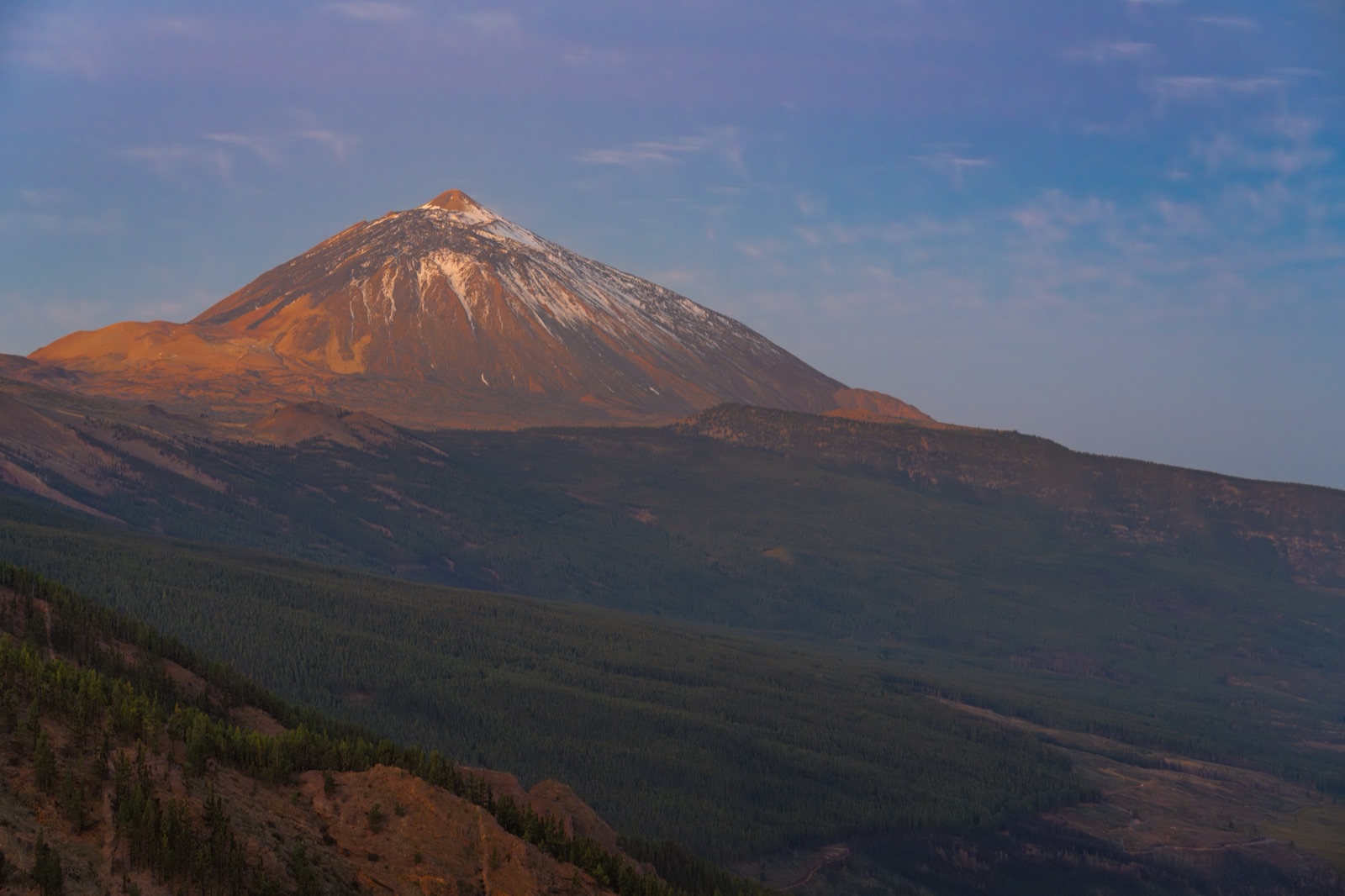
On the approach from the north, below the park boundary, the TF-21 passes through a patch of Canary Island pine before reaching the caldera rim. Mirador de Chipeque is the first pull-off that gives an unobstructed view of Teide above the forest. The critical element is the cloud sea.
On most days the trade-wind inversion sits at an altitude that traps a layer of cloud against the north coast of Tenerife. From Chipeque you look south across the cloud tops, with the mountain rising clear above them. The effect is strongest in the morning, before the sun burns the cloud layer ragged. By early afternoon the view is often a clean slope of pine and pumice, still impressive but missing the drama.
Chipeque is also a good place to judge the weather: if the summit is free of cloud here, it is likely to be clear higher up. The parking is a small paved area that fills early. Arrive before 09:00 in summer, before 10:00 in winter.
Mirador de Samara
On the TF-38, the road that runs west from the Parador towards Chío, Mirador de Samara overlooks the Samara lava cone and the black tongue of the 1798 Narices del Teide eruption. That eruption lasted three months and produced the longest lava flow in Tenerife’s historical record, reaching the coast at Puerto de Santiago.
The cone itself is a ragged scoria heap of modest height, with a shallow crater on its west side. The lava field below it is a jumble of black aa blocks, studded with the occasional yellow-green patch of retama. The view is intimate: you are looking at a specific event, not a landscape. The mirador faces south-east, so