Geology
What Type of Volcano Is Teide? Stratovolcano, Explained
If you stand on the summit of Teide and look down its flanks, you are looking at a mountain built from layers. Not a single dome, not a broad shield, but a stack of lava flows and fragmental debris, each representing a different moment in the volcano’s life. That is what defines a stratovolcano (also called a composite volcano), and Teide is one of the most instructive examples of the type in the Atlantic.
But the story is not simple. Tenerife does not behave as a single volcano. The island’s older bulk is shield-like, built of runny basalt. Teide itself, sitting inside the Las Cañadas caldera, is the steep, silica-rich stratovolcano that grew on top. Understanding the difference is not a classroom exercise. It changes what kind of eruption you should expect, where it happens, and why.
What defines a stratovolcano
A stratovolcano is built of alternating layers of solidified lava, volcanic ash, pumice, and other fragmental material. Each eruption adds a new layer. Over thousands of years, this produces the steep, roughly conical profile that most people picture when they think of a volcano.
The key driver is magma viscosity. Stratovolcanoes are fed by magma that is relatively rich in silica. Silica makes magma sticky. Sticky magma does not flow far before it cools and solidifies, so it piles up close to the vent. The same stickiness traps volcanic gases, which build pressure until they escape explosively. That is why stratovolcanoes produce both lava flows and explosive eruptions, the two kinds of material that create the layers.
Compare this with a shield volcano. Shield volcanoes, like Mauna Loa in Hawaii, are fed by low-silica basalt magma that flows easily. It spreads in broad, thin sheets, building a wide, gently sloping dome. Eruptions are typically effusive (lava fountains and flows) rather than explosive. The shape is the direct result of the magma chemistry.
Teide’s cone is built substantially of phonolite, a silica-rich volcanic rock that is viscous even by stratovolcano standards. That is why the mountain rises so steeply from the caldera floor: the magma could not spread far, so it stacked.
Tenerife’s two volcanoes in one
What complicates the picture is that Tenerife is not a single volcanic edifice. It behaves as two different types of volcano, layered in time.
The island’s older, deeper structure is a basaltic shield volcano, built by repeated effusive eruptions along three rift zones that radiate from the centre. These eruptions produced the broad, gently sloping mass that forms most of Tenerife’s land area. The basalt is runny, the slopes are shallow, and the eruptions were comparatively quiet, the kind that builds shield volcanoes. The island’s oldest subaerial rocks date to roughly 12 million years ago, when Tenerife first emerged above sea level.
Then, about 180,000 years ago, a giant landslide removed the island’s north flank, forming the Icod valley. The collapse created the Las Cañadas caldera. Inside that caldera, a new volcanic centre began to grow: the Teide-Pico Viejo complex. This is the stratovolcano. Its magma is more evolved, richer in silica, and far more viscous than the basalt that built the rest of the island. Pico Viejo, the second peak at 3,135 metres, has its own crater about 800 metres across.
So Tenerife is a shield volcano with a stratovolcano sitting on top of it, inside a caldera. The two parts behave differently, erupt differently, and produce different kinds of rock.
| Feature | Shield phase (older Tenerife) | Stratovolcano phase (Teide-Pico Viejo) |
|---|---|---|
| Dominant rock | Basalt | Phonolite, trachyte |
| Magma viscosity | Low (runny) | High (sticky) |
| Typical eruption style | Effusive (lava flows, fountains) | Explosive and effusive (ash, pumice, dome growth) |
| Shape | Broad, gentle slopes | Steep, conical |
| Eruption location | Rift zones and summit vents | Summit and flank vents |
This two-part structure is not unique to Tenerife, but it is unusually clear here. You can walk from shield to stratovolcano in a single day. The Montaña Blanca trail (Trail 7) crosses the pumice slopes of the stratovolcano, then climbs past the Altavista refuge to the summit, passing through layers that record both phases.
Where eruptions happen, and where they don’t
A common misunderstanding is that Teide’s summit is the most likely place for the next eruption. The historical record suggests otherwise.
All of Tenerife’s historical eruptions (the ones documented since the conquest in the late 1400s) have occurred on the flanks or the rift zones, not at Teide’s summit. The 1706 Trevejo eruption, also known as Montaña Negra, produced lava flows that buried the port of Garachico, destroying much of the town. The 1798 Narices del Teide eruption broke out on the flank of Pico Viejo, at the vent called Chahorra. It lasted about three months and is the longest historical eruption on Tenerife, producing both lava and significant explosive activity. The most recent eruption, Chinyero in 1909, lasted only about ten days and occurred on the northwest rift.
This pattern is typical of stratovolcanoes that sit inside a caldera above a basaltic shield. The summit conduit is often plugged by viscous magma, while the rift zones provide easier pathways for magma to reach the surface. When an eruption comes, it is more likely to open a new vent on the flank than to blow the top off.
That does not mean the summit is inactive. Monitoring by INVOLCAN and IGN, using seismometers, GPS deformation measurements, and gas sampling, tracks activity across the whole island. The summit area shows signs of ongoing degassing and minor seismic activity. But the historical pattern is consistent: the next eruption will probably not be at the summit.
The caldera connection
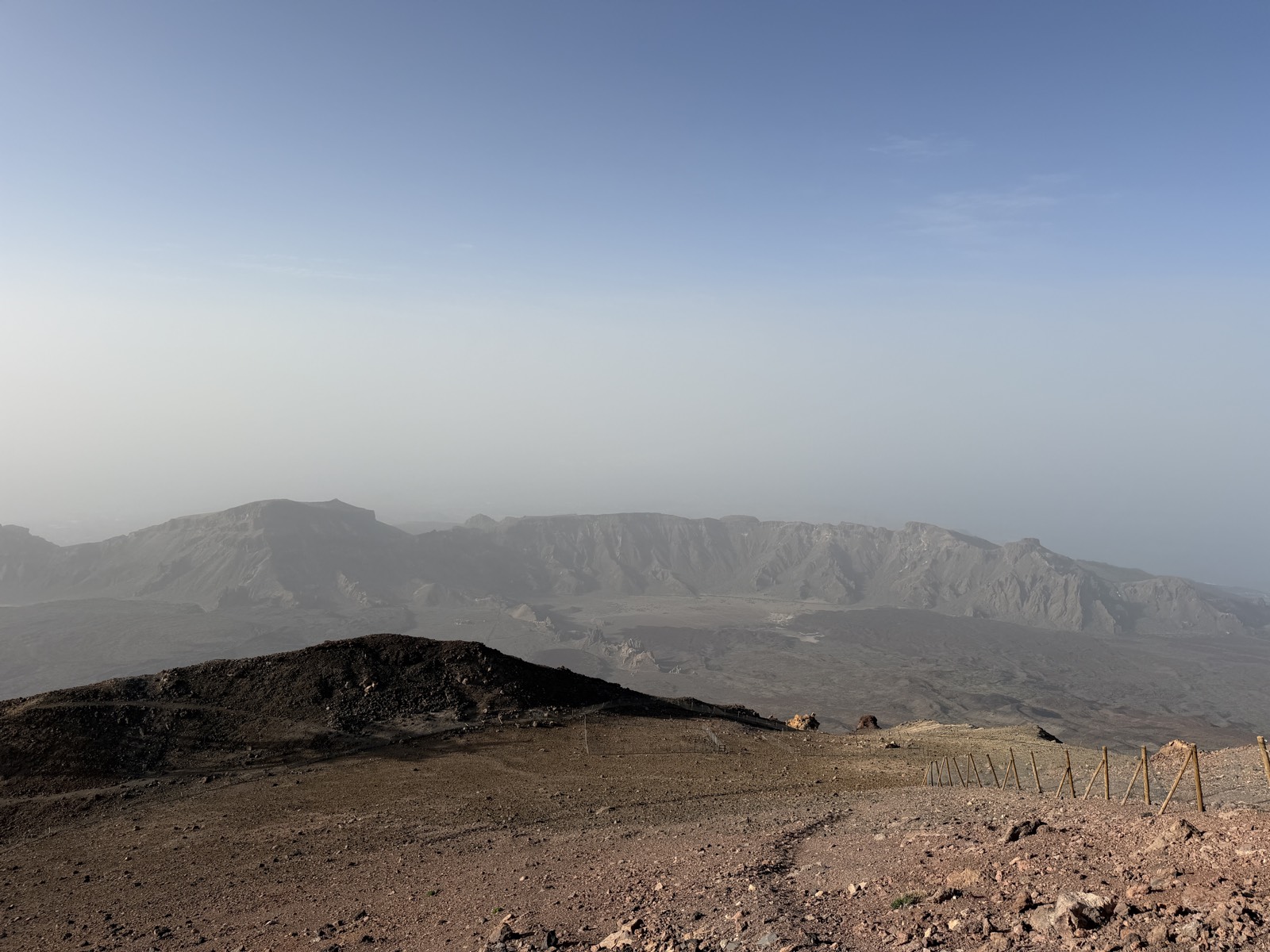
Teide is also a caldera-related volcano. It grew inside the Las Cañadas caldera, a depression roughly 16 kilometres by 10 kilometres, whose rim reaches about 2,700 metres at Guajara. The caldera was not formed by a single explosive eruption. It is the result of a series of giant landslides and collapse events, the most recent of which removed the island’s northern flank. The scar left behind became the basin in which the Teide-Pico Viejo complex later grew.
This matters for understanding the volcano’s behaviour because the caldera walls act as a structural constraint. The stratovolcano is not free to spread in all directions; it is bounded by the caldera rim. That is one reason why Teide is so steep on its northern side, where it abuts the caldera escarpment at La Fortaleza.
The caldera also influences where magma rises. The rift zones that feed the flank eruptions are aligned with the caldera’s structural weaknesses. The entire system (shield, caldera, stratovolcano) is mechanically connected.
In 2004, a seismic swarm of small earthquakes rattled the island, raising public concern. No eruption followed, but the episode, known as the 2004 seismic crisis, sharpened the monitoring effort and reminded scientists that the system is alive. Since then, continuous GPS and gas measurements have been expanded.
What this means for an eruption
If Teide erupts again, and it will on geological timescales, the eruption style will depend on where it happens.
A flank eruption on one of the rift zones would likely be basaltic and effusive, similar to the 1909 Chinyero eruption: lava flows, some fountains, limited explosive activity. It would be dangerous to anything in the flow path but unlikely to produce a large ash column.
An eruption from the central stratovolcano, from Teide’s summit or from Pico Viejo, would be a different matter. The magma there is more evolved, more viscous, and richer in gas. An eruption from that system could be explosive, producing ash fall, pyroclastic flows, and dome collapse. The 1798 Narices del Teide eruption was of this type: it lasted about three months and produced both lava and significant explosive activity. The 1706 Trevejo eruption, while effusive in its lava flows, also had explosive phases.
The monitoring networks are designed to detect the precursors: ground deformation, gas changes, and seismic swarms, well before any eruption begins. The 2004 seismic crisis demonstrated that the system can become restless without leading to an eruption, but it also showed that the island’s monitoring infrastructure is capable of detecting change.
A volcano that refuses simple labels
Teide is a stratovolcano. But that label only captures the central cone. The island as a whole is a shield volcano with a stratovolcano growing inside a caldera on top of it. The two structures coexist, fed by different magma systems, and they produce different kinds of hazard.
For the visitor standing at the cable car station or walking the trail to the summit, the visible shape tells the story. The steep cone, the pale pumice slopes of Montaña Blanca, the dark basalt of the older flows: each layer is a record of the volcano’s dual nature. The stratovolcano is the part you see, but the shield is what holds it up. That duality is what makes Teide not just a mountain, but a textbook in volcanic geology.