Culture & film
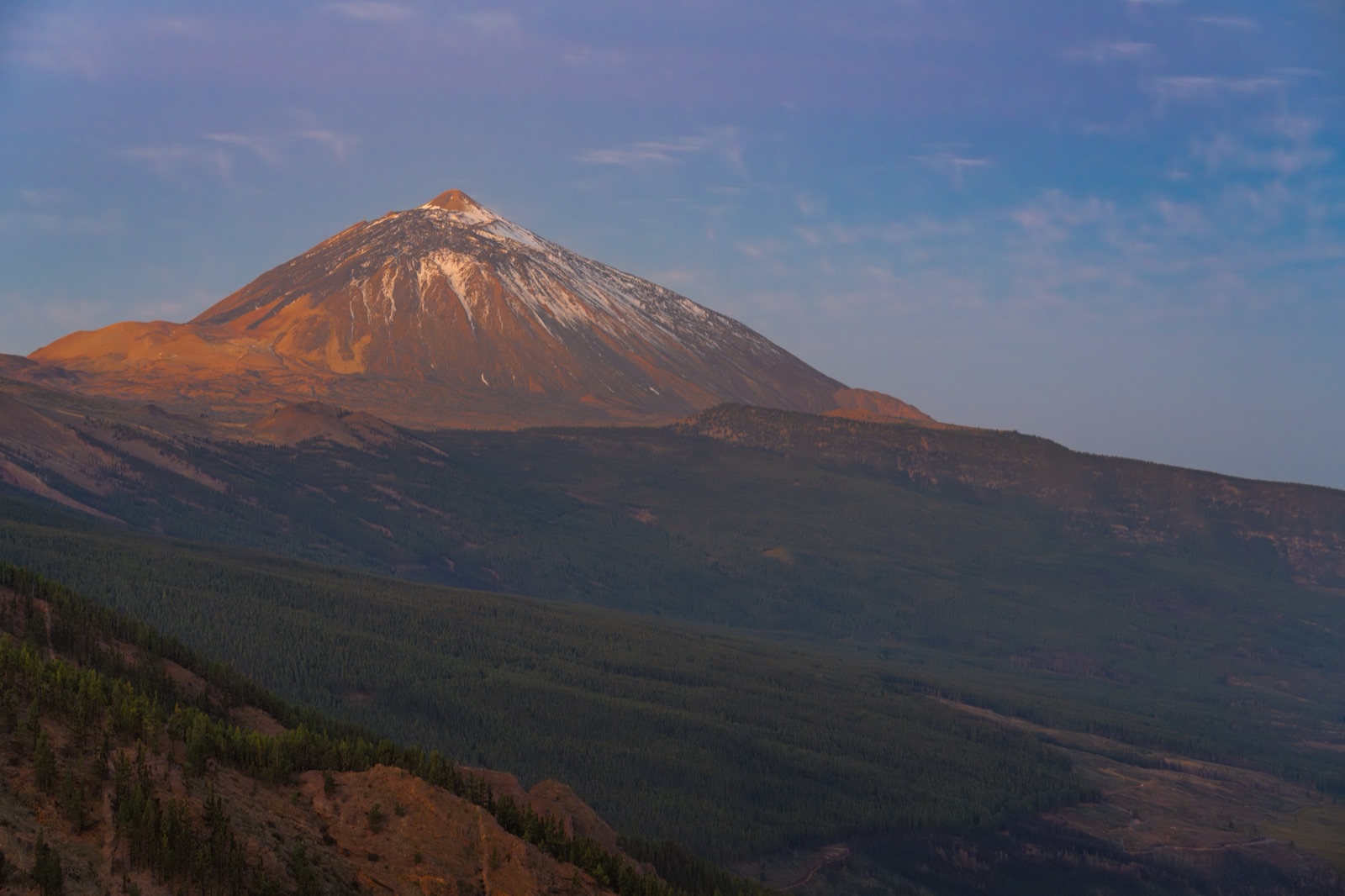
Teide's Shadow: The Largest Shadow Cast Over Sea
The shadow is the first thing you notice if you are on the mountain at daybreak and look west. It is a perfect dark triangle laid across the cloud sea, its apex pointing away from you, its base at the mountain’s feet. It looks as if a smaller volcano is out there, or as if the cone has been traced onto the sky. In fact it is neither. The triangle is an optical consequence of where you are standing, and it tells you more about perspective than about the shape of Teide.
This article explains why the shadow takes that form, how the geometry works, and when the effect is at its most visible.
A shadow that is a volume, not a silhouette
A shadow on a wall is a two-dimensional copy of the object that blocks the light. The shadow of Teide on the Atlantic is not that. It is the cross-section of a long three-dimensional volume of unlit air, stretching away from the mountain for tens of kilometres. You are seeing that volume end-on, from beside its source, and perspective does the rest.
Any long straight-sided volume converges to a point when viewed from one end. A railway track does it. A road does it. The unlit air behind Teide does it too. The mountain’s real outline is irregular, with multiple summits and a broad base, but those irregularities are compressed into the first stretch of the shadow. Beyond that, the volume’s edges are defined by the cone’s outer slopes, which are straight enough over distance, and they converge to a point on the horizon. The result is a near-perfect triangle even though the mountain is not a neat pyramid.
The same effect can be seen from any high peak at sunrise or sunset, but Teide shows it better than most because it stands alone. There is no neighbouring ridge to complicate the silhouette, and the shadow falls onto a uniform surface of cloud or sea that displays it cleanly.
Why it falls west at dawn and east at dusk
The shadow always points away from the sun. At sunrise the sun is in the east, so the shadow stretches west across the island. At sunset the sun is in the west, and the shadow runs east, out over the ocean toward Gran Canaria.
The view matters as much as the direction. To see the shadow properly you need to be high on the mountain, looking away from the sun, with the shadow between you and the horizon. From the summit cone at dawn, that means looking west over Las Cañadas and the island’s interior. From the same spot at sunset, you turn east and watch the shadow run out to sea. The upper cable-car station at La Rambleta (3,555 m) works for both, as does the summit cone itself for those with a permit, and the Pico Viejo viewpoint on Trail 11.
The shadow is at its most dramatic in the first and last minutes of the sun being above the horizon. When the sun is high, the shadow is short and falls almost directly beneath the mountain. As the sun approaches the horizon, the shadow lengthens rapidly, and in the final minutes it stretches across the entire visible sky. Then the sun moves just below the horizon and the shadow dissolves into twilight.
| Time | Shadow direction | Best seen from |
|---|---|---|
| Sunrise | West, across the island | High on the mountain, looking west |
| Sunset | East, out over the Atlantic | High on the mountain, looking east |
A shadow over sea, not land
Most mountain shadows fall on other land. Teide’s falls on the ocean and the cloud sea, which is why it is so often described as one of the largest shadows cast over sea anywhere. The description is worth keeping as what it is: a common and reasonable claim, not a surveyed record. No one has measured every maritime shadow on Earth, and the effect depends on clouds and viewing position as much as on the mountain itself. What is certain is that Teide is tall enough, isolated enough, and close enough to the ocean to produce a shadow of unusual size and clarity.
The shadow’s full length is hard to state precisely because its endpoint is usually lost in haze or cloud. On a clear evening it can be traced across the sea for a very long way before it fades. The practical point is that the shadow is longest when the sun is lowest, so the first and last minutes of daylight are the ones to be in position for.
The pink band above the shadow
Look above the shadow at sunset and you will often see a pale pink band running parallel to the horizon. This is the Belt of Venus, more properly called the anti-twilight arch. It is caused by backscattered sunlight: the sun is below the horizon from your perspective, but its light still reaches the upper atmosphere on the far side of the sky, and the long path through the atmosphere scatters the shorter wavelengths, leaving the pink and purple tones.
The shadow and the arch are two halves of the same moment. The dark triangle is the volume of air the mountain blocks from the sun; the pink band is the volume of air that still catches its light. Between them they show the full geometry of sunrise and sunset from a high place. The arch is usually visible for only a few minutes, and it is strongest when there is dust or moisture in the atmosphere to scatter the light.
Where the effect has been seen from
The shadow is best appreciated from the mountain itself, but it has been observed from a surprising distance. Pilots and passengers on aircraft approaching Tenerife from the east sometimes see it cast across the cloud layer below. From the western side of the island, at sea level, the shadow is less obvious because you are inside it: at sunset the entire western flank of Tenerife is in the mountain’s shade, and the triangle is only visible to someone looking back toward the sun from outside the shadow’s path.
The most reliable viewing position is on the mountain, looking away from the sun. The walk up the Montaña Blanca track (Trail 7) offers good views of the shadow at dawn, when the sun rises behind the summit cone and the shadow falls across the caldera and out to the west. The Roques de García circuit (Trail 3) gives a lower but still striking view, with the rock formations silhouetted against the shadow. For a planned visit, the Teide National Park guide covers the practicalities of getting to the right place at the right time.
The same geometry, seen elsewhere
The triangular shadow is not unique to Teide. Any isolated peak with a simple cone shape produces it at sunrise and sunset. What varies is the setting. On Etna the shadow falls across Sicily and the sea beyond; on Kilimanjaro it stretches over the savannah; on Mauna Kea it runs across the Pacific. Teide’s distinction is that it is an island peak, surrounded by ocean on nearly every side, so the shadow’s surface is almost always sea or cloud rather than land.
The triangular form is also a reminder that the mountain’s apparent shape depends on where you view it from. From the north, Teide looks like a broad shield with Pico Viejo beside it. From the east, it appears as a single sharp cone. From the summit looking down, it is neither. The shadow is the one view that shows the mountain as a pure geometric form, and it does so by hiding the mountain entirely.
A short-lived phenomenon
The shadow’s most remarkable feature is also its most inconvenient: it does not last. From the moment the sun clears the horizon to the moment the shadow reaches its full length is only a few minutes, and then it fades as the sun climbs and the shadow shortens. The same is true in reverse at sunset. Anyone who wants to see it needs to be in position before the sun gets low, not after.
The conditions also have to cooperate. The shadow is most visible when there is a cloud sea below the mountain, because the cloud surface shows the shadow as a dark shape against a brighter background. On a completely clear day the shadow falls on the ocean, which is darker and shows less contrast. On an overcast day there may be no view at all. The weather is the deciding factor, and it is genuinely variable.
There is a particular pleasure in watching the shadow from the summit cone at dawn, with the sun rising behind you and the triangle stretching across the entire western sky. For a few minutes the mountain seems to be projecting itself onto the world, and then the sun climbs and the projection is gone. It is the mountain’s briefest and most elegant trick, and it is worth the early start.