Geology
The Rocks of Teide: Basalt, Phonolite and Obsidian
Montaña Blanca is the easiest place on Teide to read the mountain’s geology. Its name says what it is: a cone built almost entirely of pale pumice, set against the dark basalt and scoria around it. This article is a field identification guide to the rocks a visitor can actually see and touch along the TF-21 and the park’s trails, and to the clues that show how old a given surface is. The method is simple, and it begins with five names.
A short vocabulary of volcanic rock
Five terms cover almost everything you will meet on the mountain. All five appear within sight of the road or the lower trails. The table below sets out what each looks like, how it forms, and where it stands out in the landscape.
| Rock | What it looks like | How it forms | Where it stands out |
|---|---|---|---|
| Basalt | Dark grey to black, fine-grained, rough and blocky | The island’s foundational lava, erupted along rift zones | The dark flows across the caldera floor |
| Phonolite | Pale grey, sometimes greenish, dense | Silica-rich, viscous lava; much of Teide’s own cone | The upper cone and summit mass |
| Pumice | Pale, frothy, full of gas bubbles; floats | Lava that cooled with its gas trapped | Montaña Blanca and the pale pumice fields |
| Obsidian | Black volcanic glass, sharp curved fracture | Lava that cooled too fast to crystallise | Some of the younger flows |
| Scoria | Dark, bubbly, cinder-like fragments | Lava fragments that cooled in the air | The cinder cones |
The practical distinction is visual, not chemical. Three questions identify almost everything on Teide: dark or pale? Dense or frothy? Glassy or rough? The answers sort each rock into one of these five categories.
Where you stand matters. The TF-21 enters the park at El Portillo in the north and runs into the caldera of Las Cañadas, roughly 16 km by 10 km. The cable car base station at 2,356 m sits on the same road below the cone. The northern rim of the caldera is the escarpment known as La Fortaleza. The main walking routes are the Montaña Blanca track, the Roques de García circuit and the summit path from the cable car’s upper station. The great rock wall of Roques de García, which separates the Llano de Ucanca from the rest of the caldera floor, holds the pillar known as Roque Cinchado, the stone tree that appeared on the old 1,000-peseta banknote.
Basalt: the island’s foundation
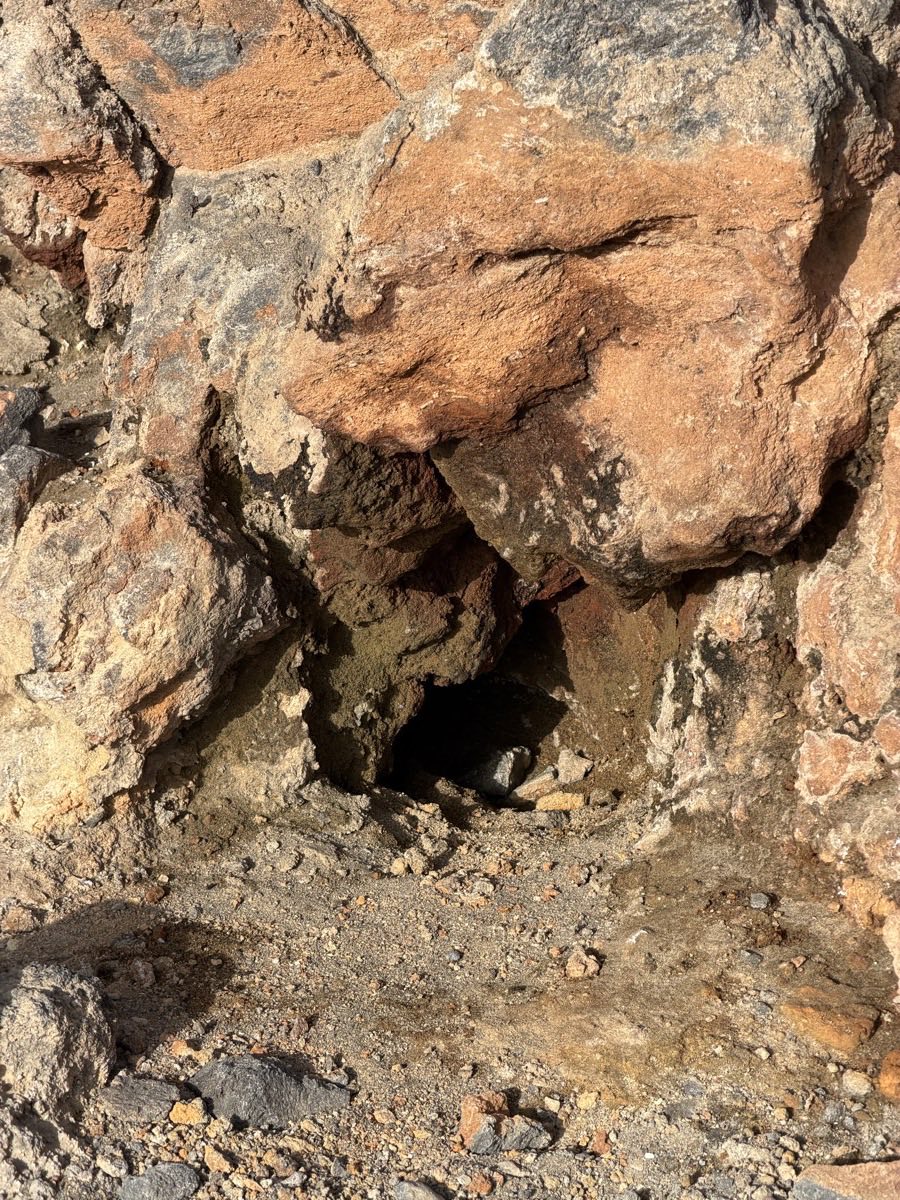
Basalt is the dark, fine-grained rock that makes up the older bulk of Tenerife and the flows of its rift zones. It is the island’s foundation: the material the rest of the volcanic pile has built upon. In the hand it is dense and heavy, dark grey to black, and flow surfaces are often rough and blocky where the crusted lava broke and tumbled as it advanced.
Most of what looks black in Las Cañadas is basalt, or the scoria that forms when the same kind of lava erupts with gas. The caldera floor, the lower slopes of the great walls, the flows that ran towards Llano de Ucanca: all are dominated by it. Basalt erupts hot and fluid, so it spreads in sheets rather than piling into steep cones. That is why the dark ground of the caldera sits so flat beneath the cones and peaks built above it.
The blocky, broken surface of an old flow is worth stopping for. It records the way the lava moved: a crust formed on the cooling surface, the moving mass broke it apart, and the fragments were carried along and tumbled. The same process, repeated, built the dark expanses of the caldera floor.
Phonolite: the pale rock of the summit cone
Phonolite is the pale exception to the dark rule. It is silica-rich and viscous, so it moves sluggishly and builds steep, thick masses where basalt would have spread. A large part of Teide’s own cone, rising to 3,715 m, is phonolite, and its pale grey, sometimes greenish tone is what gives the summit its washed-out colour against the sky.
The name preserves a field test. “Phonolite” comes from the Greek for sound: thin slabs of the rock ring when struck. Because the lava is viscous, it holds its gas rather than releasing it steadily, and phonolite eruptions tend to be explosive.
The Guanches called the mountain Echeyde and read its pale summit as the plug that sealed Guayota inside after the god Achamán defeated him. The paleness is real enough: the upper cone is largely phonolite, and its colour is one of the first things you notice from the caldera floor. The myth and the geology agree that the summit is a lid of pale rock.
Pumice and the white mountain
Pumice is the pale, frothy rock, so full of gas bubbles that a piece dropped in water would float. It forms when gas-rich lava is depressurised suddenly: the dissolved gas expands into bubbles, and the lava freezes into froth before the bubbles can escape. No other rock on the mountain is light enough to do the same.
Montaña Blanca is built of pumice, and the cone takes both its colour and its name from the material. It sits against the black basalt around it, and that contrast is the clearest geological signal in the park: dark flows, pale pumice. A pumice cone records an explosive eruption: the same gas expansion that made the rock frothy also drove the eruption column. The cone’s slopes are loose and pale underfoot, and the standard walking ascent, Trail 7, runs from here to the Altavista refuge; the Teide hiking guide covers the route in detail.
Along the track you may notice the rounded masses known as Los Huevos del Teide, accretionary lava balls built up as hot fragments gathered layers while they tumbled. The same pale material fills the pumice fields of Minas de San José, a landscape bare enough to have been used as a planetary analogue and a film location.
Obsidian and scoria: glass and cinder
Obsidian is volcanic glass. Where other lavas cooled slowly enough for crystals to grow, obsidian chilled so fast that no crystals had time to form, and the result is black, glossy and sharp. It breaks with the curved, shell-like fracture known as conchoidal, and the edges it leaves are sharp enough to cut. On Teide it appears on some of the younger flows.
Scoria is the dark counterpart to pumice. It is bubbly like pumice, but darker, denser and rougher, with a cindery surface. Where pumice floats, scoria sinks. It builds the cinder cones, the dark, rough-sided hills that stand among the flows.
The two are easy to confuse at a distance, and the quick test is colour and weight: pale and light means pumice; dark and heavy means scoria. Both come from gas-rich eruptions; the difference is how much gas stayed trapped in the cooling lava.
Reading age from the surface
Lichen is a field geologist’s clock, of a rough sort. A fresh lava flow is bare, black and rough. Over time, lichens spread across it, the surface weathers to lighter tones, and soil begins to gather in the cracks. The rule of thumb on Teide is simple: bare and black means young.
The rule is relative, not absolute. It tells you which of two surfaces is older, not how many years separate them. The historical record gives you something to calibrate against: the most recent eruption on Teide itself was at Narices del Teide, on the flank of Pico Viejo, which ran for about three months in 1798 and is the longest historical eruption on the island. The most recent eruption anywhere on Tenerife was Chinyero in 1909, which lasted about ten days.
Those dates are your calibration points. A flow that looks freshly broken, with a black surface and no lichen, is recent in the island’s eruptive record; a surface pale with lichen and softened by weathering has been exposed far longer. The same logic applies to the pale rocks: the loose, pale slopes of Montaña Blanca mark it as young in relative terms, while the walls of the caldera have been weathering far longer. That is the whole method, and it is enough to make the landscape legible.
A protected landscape
Everything on the mountain is protected. Teide National Park was created in 1954 and inscribed as a UNESCO World Heritage site in 2007, and the geology is part of what the designation covers. Collecting rock samples is prohibited. The rule is not a formality: the pumice fields and the glassy flows are a scientific archive, and every removed stone is a small piece of the record gone.
The same reasons that make collecting wrong make the mountain a live subject rather than a finished one. Teide is an active volcano, dormant rather than extinct, and INVOLCAN and IGN monitor it with seismometers, GPS and GNSS deformation networks and volcanic-gas measurements. The bare black flows are not scenery from a closed story. They are the most recent lines in a record that is still being written.