Geology
Phonolite: The Ringing Rock That Built Teide's Cone
The pale rock that makes up much of Mount Teide’s summit cone has a party trick. Strike a thin slab of it and it rings: a clear, metallic note, like a struck bell or a tuned stone. The property gave the rock its name: phonolite, from the Greek phone for sound. In the Canary Islands, where basalt is the everyday volcanic rock, phonolite is the exception that explains the mountain’s shape.
Teide is not a simple pile of basalt. The island’s bulk is basaltic: dark, fluid lava that built the broad shield of Tenerife over millions of years. But the central cone, the 3,715-metre pyramid that draws visitors from across the world, is made of something different. Phonolite magma is viscous. It does not flow far. It piles up, steep and steep-sided, and it traps gas. That chemistry, and the contrast with the basalt around it, is the geological story of the mountain.
What phonolite is
Phonolite is a fine-grained volcanic rock, typically pale grey, sometimes with a faint greenish cast. It is classified as an intermediate to felsic rock: richer in silica than basalt, poorer than rhyolite. But what matters for the landscape is not the exact chemistry but the behaviour it produces.
The name “sounding stone” dates to the early nineteenth century, when German geologists noticed that slabs of the rock from certain European localities rang when struck. The effect is real: phonolite’s mineral grains are tightly interlocked, and a thin, dry piece can vibrate at a frequency the human ear registers as a note. It is not a property unique to Teide’s phonolite, but it remains a good party piece for guides who carry a sample in their pocket.
On Tenerife, the phonolite is often porphyritic: it contains larger crystals, visible to the naked eye, set in a finer groundmass. The most common of these are feldspar crystals, sometimes sanidine, which give the rock a speckled appearance. In some flows the rock is almost black on a fresh break, weathering to the pale grey that dominates the upper mountain.
How phonolite forms
Phonolite does not come straight from the mantle. It is an evolved magma, meaning it starts as something else and changes. The process works like this.
Deep beneath Tenerife, basaltic magma rises from the mantle and collects in a chamber. There it sits, cooling slowly. As it cools, the first minerals to crystallise: olivine, pyroxene, calcium-rich feldspar. These are denser than the remaining liquid and sink. The melt left behind is poorer in those elements and richer in silica, aluminium, and alkalis. Over time, a single batch of basaltic magma can evolve into a phonolitic one, given enough residence time in the chamber and enough crystal settling.
This is why phonolite is relatively uncommon worldwide. It requires a magma chamber that stays active long enough for differentiation to run its course, and then an eruption that taps the evolved top of the chamber rather than the deeper, more primitive magma. The Canary Islands, with their long-lived volcanic systems and complex plumbing, produce phonolite in several of the central volcanoes: Teide, Pico Viejo, and the older Las Cañadas edifice among them.
Why phonolite builds steep cones
The key property is viscosity. Basaltic magma, at high temperature, flows like warm honey. It can travel tens of kilometres from its vent, building the low, broad slopes of a shield volcano. Phonolitic magma is cooler and stickier. It does not run; it oozes, domes, and piles up.
When phonolite erupts, it tends to form one of two things. If it is relatively gas-poor, it may extrude as a lava dome: a rounded, steep-sided mound that grows by inflation from within. If it is gas-rich, the trapped volatiles can drive explosive eruptions, producing pumice falls and pyroclastic flows. Teide has seen both styles.
The summit cone is a composite of phonolitic lava flows, domes, and pyroclastic layers, each episode adding height and steepness. The result is a cone with steep slopes in places, a profile that looks nothing like the gentle gradients of the basaltic rift zones that radiate from the mountain. One rock type, two landscapes, one island.
A useful contrast: basalt and phonolite on Tenerife
| Property | Basalt | Phonolite |
|---|---|---|
| Colour | Dark grey to black | Pale grey, sometimes greenish |
| Silica content | Lower | Higher |
| Magma temperature | Higher | Lower |
| Flow behaviour | Fluid, travels far | Viscous, piles up |
| Landscape built | Shield slopes, lava tubes | Steep cones, domes, coulées |
| Sound when struck | Dull thud | Rings if thin and dry |
The numbers for temperature and silica are approximate and vary between eruptions. The behaviour is the point.
Where to see phonolite on Teide
The summit cone itself is the obvious place, but a permit is required to reach it. For anyone without a summit permit, the phonolite is visible in several places that are easily accessible.
The trail from Montaña Blanca to the Altavista refuge crosses a landscape of pale pumice and blocky lava that is largely phonolitic. The boulders scattered across the trail are the same rock that forms the peak above. Near the refuge, the path climbs over a phonolite coulée: a thick, stubby lava flow that moved like a glacier of rock, slowly enough that its surface crust crumpled into ridges still visible today.
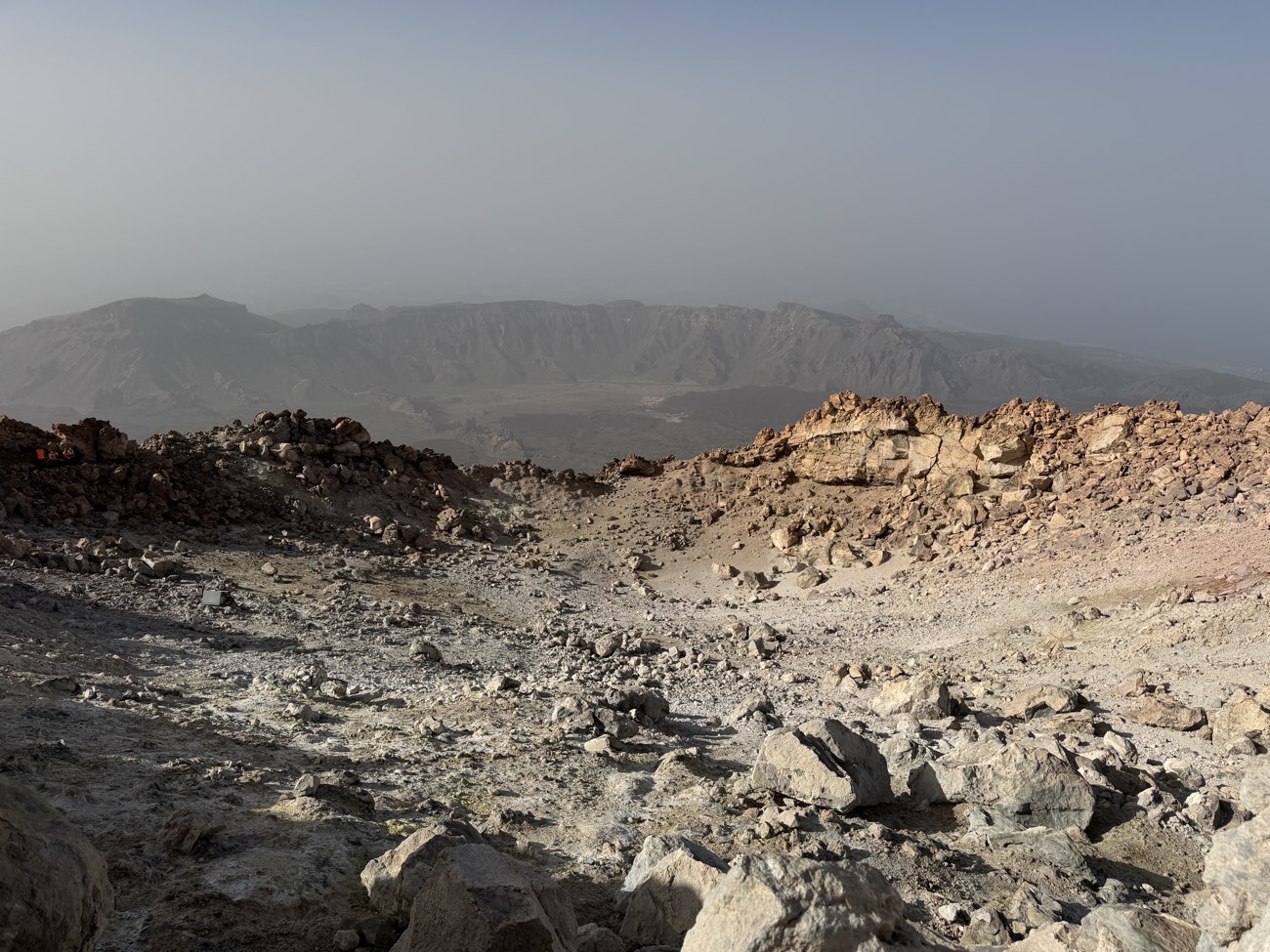
At the cable car’s upper station, La Rambleta, the rock underfoot is phonolite. The short walk to the Mirador de la Fortaleza viewpoint crosses a surface of pale, rough lava that has been weathered by frost and wind into a sharp, clinkery texture. It is not a comfortable surface to sit on, but it is a good place to see the rock in place, unweathered on a fresh break where a stone has been kicked loose.
Pico Viejo, the 3,135-metre satellite cone west of the main summit, is also built of phonolite. Its crater, roughly 800 metres across, is the source of a major phonolitic eruption about 2,000 years ago that produced the Montaña Blanca pumice cone. The pumice there, pale and lightweight, is the same magma that was blown apart by expanding gas: the explosive side of phonolite’s personality.
The link to obsidian
On some of the younger flows around the mountain, especially on Pico Viejo’s flanks, you may find obsidian. It is not a separate rock type. Obsidian is volcanic glass, formed when magma cools so fast that crystals do not have time to grow. The same phonolitic magma that produces pale grey crystalline rock can, if it chills rapidly against air or cold ground, form black glass.
The obsidian on Teide is typically dark, sometimes with a faint brown or green translucency when held to the light. It is not abundant: the flows that produced it are localised. But it is a useful reminder that the distinction between rock types is about cooling history as much as chemistry. The same magma, cooled slowly, makes phonolite; cooled fast, it makes obsidian.
What phonolite tells us about Teide’s future
The presence of phonolite in the cone is evidence of a long-lived, differentiating magma chamber beneath the mountain. That chamber is still there. Monitoring by INVOLCAN and IGN tracks seismometers, GPS deformation, and gas measurements. The system is active, not extinct.
Phonolitic eruptions are less frequent than basaltic ones on Tenerife, but they are the ones that produce the most energetic events. The 1798 eruption at Narices del Teide, on Pico Viejo’s flank, was phonolitic. So was the Montaña Blanca eruption around 2,000 years ago, which produced a substantial pumice fall. The historical record is short, and recurrence intervals are long, but the pattern is clear: when the evolved magma erupts, it does so with more force than the basalt that built the island’s bulk.
None of this means an eruption is imminent. The monitoring data shows no sign of unrest that would lead to a short-term forecast. But the rock itself is a record of what the system can do, written in pale grey stone that rings when you strike it.