Astronomy
Teide Observatory: Europe's Solar Telescope Capital
The Observatorio del Teide does not sit on the volcano’s summit. It occupies a broad saddle on the eastern rim of the Las Cañadas caldera, at Izaña, about 2,390 metres above the Atlantic. The distinction matters. The summit is a place of rock and thin air; the observatory is a working scientific installation, one of the world’s most important centres for solar physics, and it became that precisely because it is not on the peak but on this particular stretch of high, stable ground.
Operated by the Instituto de Astrofísica de Canarias (IAC), the Teide Observatory forms one half of the Canary Islands observatories — the other being the Roque de los Muchachos Observatory on La Palma. Together they host more than a dozen nations’ telescopes, but Teide’s speciality is the Sun. Three major solar telescopes dominate the site, and a quiet array of night-time instruments fills out the rest.
The site
The observatory sits inside the national park boundary but outside the main visitor flow. The road that reaches it, the TF-24, climbs through pine forest and emerges above the cloud layer into a landscape of pale pumice and dark lava. The buildings are low, mostly white, clustered around a small complex that includes a residence for astronomers, control rooms and telescope domes of varying design. Some are classic white hemispheres; others are angular towers built for a single purpose.
The elevation — 2,390 metres — is high enough to place the telescopes above the trade-wind inversion that caps the lower atmosphere over Tenerife, but not so high that the logistics of construction and daily operation become punishing. It is a deliberate, measured altitude, chosen for a specific atmospheric phenomenon.
Why Izaña?
The north-east trade winds that dominate Tenerife’s climate push moist Atlantic air against the island’s northern slopes. As that air rises, it cools and condenses into a near-permanent bank of cloud below the observatory. Above that, the air is dry, stable and remarkably transparent. The boundary between the two — the inversion layer — acts like a lid, preventing the turbulent, moisture-laden lower atmosphere from mixing upwards. The result is a stratum of exceptionally still, clear air over the caldera rim.
For astronomers, this translates into good “seeing” — the term for how much the atmosphere smears a point source of light. Steady air means sharper images, and a high proportion of clear nights means more data. Izaña’s combination of altitude, dryness and the inversion layer makes it one of the best sites in Europe for both solar and night-time observing. The Sun, when studied in detail, demands the same atmospheric stability as a faint galaxy: turbulence distorts the fine structure of the solar surface just as it blurs a star.
The choice of Izaña was not an accident. It was the culmination of an argument that began in the 19th century.
A legacy of altitude
In 1856, the Scottish astronomer Charles Piazzi Smyth travelled to Tenerife with a set of instruments and a hypothesis: that astronomical observations made from a high mountain would be superior to those made at sea level. At the time, most major observatories were built in or near cities, close to universities and patronage, and the idea of deliberately climbing a volcano to look at the sky was eccentric.
Smyth set up his telescopes first on the slopes of Mount Guajara, at about 2,700 metres, and later on the summit of Teide itself. He measured the clarity of the air, the steadiness of star images, and the telluric absorption lines that the atmosphere imprints on spectra. His results were unambiguous. The mountain outperformed the lowlands in every optical measure that mattered. He published his findings and argued, forcefully, that the future of astronomy lay at altitude.
It took a century for the argument to win. The Teide Observatory was built long after Smyth’s expedition, but his work is the intellectual foundation on which it stands. A plaque at the site commemorates the 1856 expedition, and the observatory’s very existence is a vindication of his mountain astronomy.
The solar telescopes
The Sun is a difficult target. Its brightness forces telescopes to cope with enormous heat loads, and the fine detail that solar physicists want — granulation patterns, magnetic flux tubes, the structure of sunspots — demands both high resolution and extreme stability. The three major solar telescopes at Izaña each approach the problem differently.
| Telescope | Type | Primary role |
|---|---|---|
| GREGOR | Open-air Gregorian reflector | High-resolution imaging and spectropolarimetry of the solar photosphere and chromosphere |
| Vacuum Tower Telescope (VTT) | Evacuated refractor | Long-term monitoring of solar magnetic fields and velocity fields |
| THEMIS | Polarisation-free reflector | Vector magnetography and chromospheric studies, optimised for measuring weak magnetic fields |
GREGOR is among the largest solar telescopes in Europe. Its open design, with no dome or window enclosing the primary mirror, avoids the problem of internal turbulence that can degrade images in enclosed telescopes. The mirror itself sits in an alt-azimuth mount, tracking the Sun across the day while adaptive optics correct for the residual atmospheric wobble that even Izaña cannot entirely eliminate.
The Vacuum Tower Telescope, by contrast, encloses its light path in an evacuated tube. This removes the internal air currents that would otherwise distort the beam. It has been a workhorse instrument for decades, building up long time series of magnetic field measurements that are essential for understanding the solar cycle.
THEMIS, a French-Italian instrument, is designed to measure polarisation with minimal instrumental contamination. That makes it particularly useful for mapping the weak magnetic fields that thread the Sun’s quieter regions and the chromosphere above them. Together, the three telescopes cover the Sun from the deep photosphere to the outer chromosphere, and from large-scale active regions down to the smallest observable magnetic structures.
Night-time instruments
The Sun is not the only object studied at Izaña. A set of night-time telescopes operates alongside the solar instruments, taking advantage of the same stable air and dark skies. These are not the giant light-buckets of La Palma or Chile; they tend to be smaller, robotic or semi-robotic systems designed for survey work, time-domain astronomy and cosmology.
Among them are telescopes that scan the sky for transient events — supernovae, gamma-ray burst afterglows, moving objects — and instruments that measure the cosmic microwave background at millimetre wavelengths. The high, dry site is particularly valuable for microwave and submillimetre observations, because water vapour in the lower atmosphere absorbs those frequencies. By sitting above the inversion layer, Izaña gives these experiments a window that would be opaque at sea level.
The night-time programme is less famous than the solar work, but it fills a complementary niche. While the world’s largest optical telescopes chase the faintest galaxies, Izaña’s smaller instruments can dedicate nights to monitoring a single star or sweeping the same patch of sky repeatedly — the kind of unglamorous, high-cadence observation that often produces the most surprising results.
The Sky Law
Astronomical sites are fragile. A single poorly shielded streetlight can ruin a dark-sky site, and aircraft contrails can degrade a night’s data. In 1988, Spain enacted Ley 31/1988, known as the Sky Law, to protect the quality of the sky above the Canary Islands observatories. The law regulates outdoor lighting across much of Tenerife and La Palma, restricts atmospheric pollution, and controls the flight paths of aircraft near the observatories.
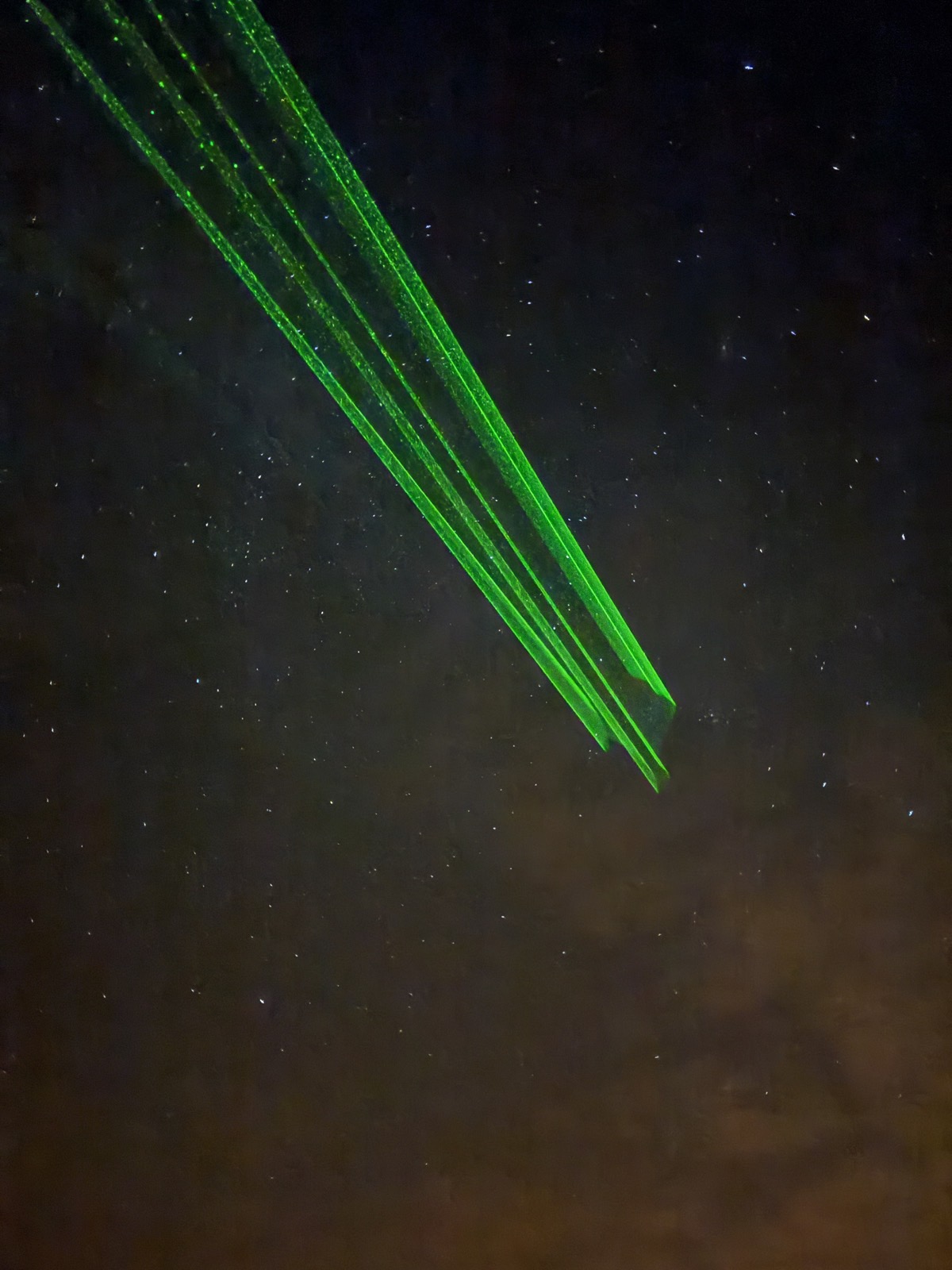
The result is visible from the moment you drive up the TF-24 after dark. The low-pressure sodium streetlights on the island emit a narrow, amber band that astronomers can filter out. The sky above the caldera is genuinely dark — not the absolute black of the Atacama, but dark enough that the Milky Way casts a shadow on a moonless night. The Sky Law is not a symbolic measure; it is enforced, and it has preserved the site’s scientific utility through decades of coastal development.
Visiting the observatory
The Teide Observatory is not a tourist attraction in the ordinary sense. It is a working laboratory, and most of its buildings are closed to the public. However, guided visits do run, booked separately from anything the national park or the cable car offers. A visit typically includes a walk through the site, an explanation of the telescopes and their research, and — depending on the time of day — a look at the Sun through a small portable telescope or a view of the night sky through a modest instrument.
Booking is essential, and places are limited. The experience is not a stargazing tour in the commercial sense; it is an introduction to professional astronomy at a working observatory. The guides are often researchers or trained communicators from the IAC, and the tone is closer to a university open day than a holiday activity. For those who want the more immersive, dark-sky stargazing that Tenerife is known for, commercial tours operate elsewhere in the national park and are covered in the stargazing guide.
The observatory’s daytime visits can be combined with a drive through the caldera, but it is worth planning the timing carefully. The site is at altitude, the sun is strong, and the road climbs through rapidly changing weather. A morning visit often catches the inversion layer at its most dramatic, with a sea of cloud below and the telescopes standing in clear, dry air.
What the telescopes see
A solar telescope does not produce a pretty picture of a golden disc. It produces data: spectra, polarisation maps, Doppler velocity fields. The Sun’s surface, seen through GREGOR at high resolution, resolves into a granular pattern of convection cells each about the size of France, constantly appearing and dissolving over minutes. Magnetic field lines emerge, twist and reconnect. Sunspots — dark because they are cooler — are the cross-sections of magnetic flux tubes that suppress convection. The fine structure of a sunspot’s penumbra, the filamentary bridges of light that cross it, and the sudden brightening of a flare are all within reach of these instruments.
The night-time telescopes, meanwhile, work on different scales. A robotic survey telescope might catch the brief flash of a kilonova — the collision of two neutron stars — and trigger follow-up observations across the world. A microwave experiment might map the faint temperature variations in the cosmic background radiation. The work is cumulative, incremental, and often decades long.
The mountain and the sky
There is a tendency to frame observatories as romantic places, and Izaña does have a certain stark beauty. At dawn, the shadow of Teide stretches across the cloud deck like a pyramid of darkness. In winter, snow can close the road and coat the domes, and the telescopes sit in a white silence broken only by the hum of tracking motors. But the romance is incidental. The site was chosen for physics, not for views.
The same inversion layer that gives the observatory its steady air also creates the visual spectacle that visitors see from the cable car or the caldera floor — the flat, bright plain of cloud that looks like a second ocean. From the observatory, that cloud is below, and the sky above it is the working medium. The telescopes do not look at the cloud; they look through the clear air above it, at a star eight light-minutes in the past, or at galaxies whose light has been travelling since before the Earth formed.
That is what the Teide Observatory is: a place where the island’s particular geography — a volcano tall enough to pierce the trade-wind inversion, set in a cold ocean current — creates a natural laboratory for watching the universe. It is not the largest observatory in the world, nor the highest, but for solar physics it has few equals, and for the quiet accumulation of long-term data it is irreplaceable.