Geology
Teide's Fumaroles: The Sulphur Smell at the Summit
The first thing you notice at the top of Spain is the smell. At 3,715 metres, with the Atlantic laid out below and the air thin enough to make every step deliberate, the summit of Teide smells of sulphur. It is not overwhelming — more a persistent whiff, like struck matches or a cellar drain — but it is unmistakable, and it is the most honest thing about the place. The volcano is still working.
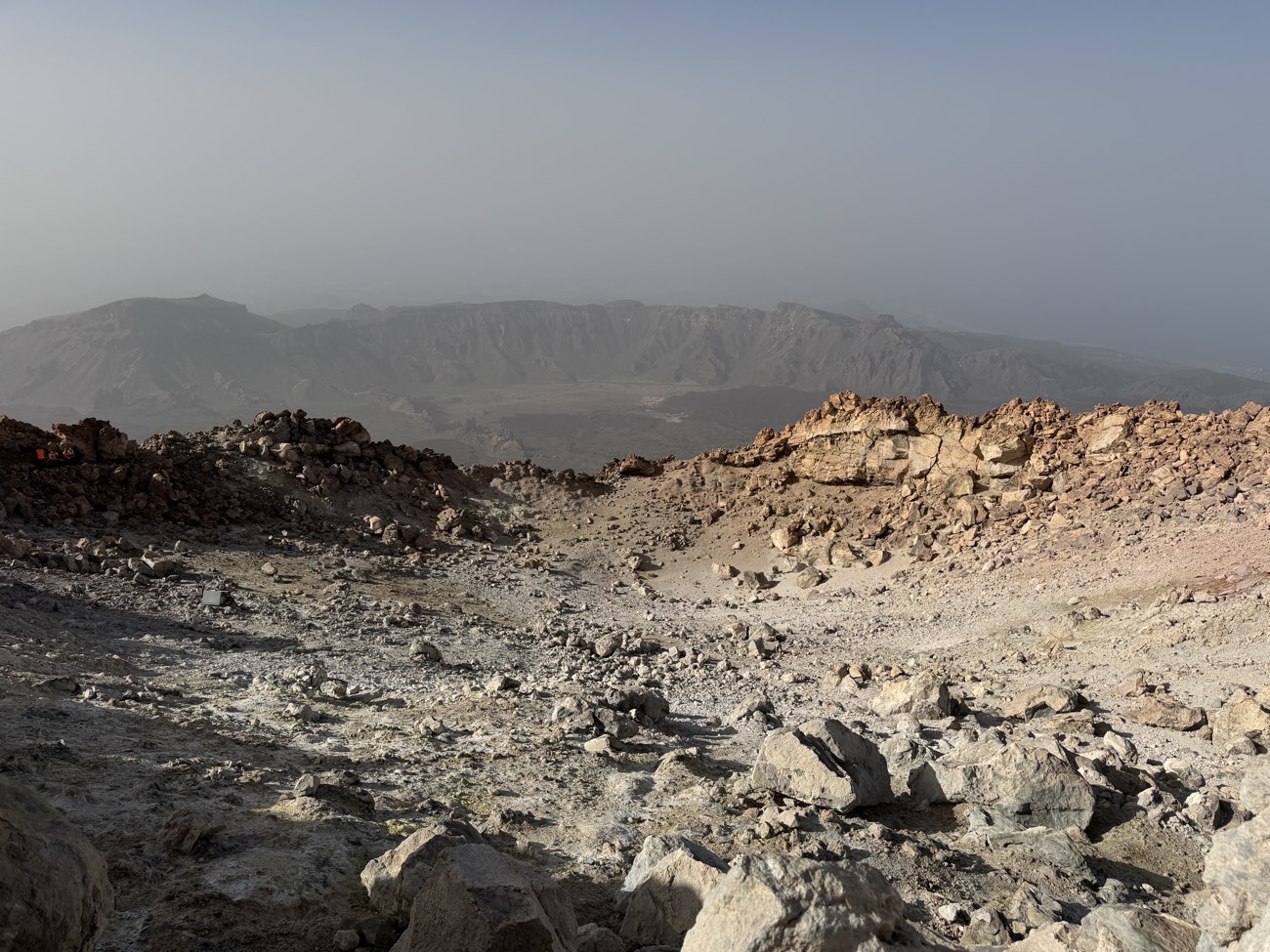
Those pale yellow crusts on the dark rock, the faint steam on a cold morning, the patch of ground that is startlingly warm under your feet: these are Teide’s fumaroles. They are not a spectacle in the way the caldera wall or the shadow of the cone at sunset are a spectacle. They are quieter than that. But they are the reason the mountain is classified as active rather than extinct, and they connect the summit directly to the magma body several kilometres below.
What a fumarole actually is
A fumarole is a vent through which volcanic gas reaches the surface. The word shares a root with fume, which is accurate enough. The gas is mostly water vapour and carbon dioxide, with a small fraction of sulphur compounds — chiefly hydrogen sulphide (H₂S) and sulphur dioxide (SO₂). It is those sulphur species that produce the characteristic smell and that deposit the pale yellow and white crusts around the vent mouths.
Teide’s fumaroles are concentrated around and inside the summit crater, on the final cone known as the Pilón de Azúcar — the Sugar Loaf. This is the highest ground in Spain, and it is also the most direct evidence that the volcano’s plumbing system is still pressurised. The gas originates from magma at depth. As the magma rises and pressure drops, dissolved volatiles come out of solution and travel upward through fractures in the rock. Where those fractures reach the surface, you get a fumarole.
The key point is that this is not residual heat from an old eruption cooling down. It is ongoing degassing from a live magmatic system. That is why volcanologists describe Teide as dormant rather than extinct, and the fumaroles are the visible reason for that distinction.
What you actually experience at the summit
The smell arrives before the view. On the final section of the Telesforo Bravo trail — the permitted path from La Rambleta at 3,555 metres to the crater rim — the wind shifts and you catch it. It is not strong enough to be unpleasant for most people, but it is persistent, and it is the first clue that the ground underfoot is not inert.
The second clue is the colour. The dark basalt and trachyte of the summit cone are streaked and patched with pale yellow and white deposits. These are sulphur crusts, precipitated as the hot gas hits the cold air and the sulphur compounds condense or react with oxygen and moisture. The effect is subtle in bright midday light, but in the low-angle sun of early morning or late afternoon the staining is obvious.
The third clue is warmth. At 3,700 metres the air temperature is often below freezing, even in summer. The rock surface is cold. But step close to a fumarole — staying on the marked path, always — and the ground under your boots is distinctly warm. The contrast is startling. It is a direct, physical reminder that the mountain is not a dead lump of stone.
In cold conditions, particularly in winter and early spring, the steam is visible too. Thin plumes rise from the vents and are torn apart by the wind. It is not dramatic — nothing at Teide’s summit is dramatic in the way an erupting volcano would be — but it is unmistakably alive.
The science: why the fumaroles matter
Volcano monitoring rests on three legs: seismicity, ground deformation, and gas geochemistry. Teide’s fumaroles are the third leg. The Instituto Volcanológico de Canarias (INVOLCAN) and the Instituto Geográfico Nacional (IGN) maintain monitoring equipment at the summit, measuring gas composition and output over time.
The principle is straightforward. Magma at depth contains dissolved gases. As the magma moves, the proportion of those gases in the volcanic plume changes. An increase in certain ratios — for example, sulphur dioxide relative to carbon dioxide — can indicate that fresh magma is rising. A decrease can suggest the system is stabilising. The fumaroles are therefore not just a curiosity; they are a data stream.
Changes in gas output and composition are interpreted alongside seismic data and ground deformation measured by GPS and GNSS stations. No single measurement tells the whole story, but together they give a picture of what is happening kilometres below the summit, where no instrument can go.
The fumaroles also alter the rock they pass through. Hydrothermal fluids — hot, acidic, gas-charged — react with the volcanic rock, weakening it and changing its colour. This is why the terrain around the vents is unstable. It is also why the crater walls show banding: zones of altered rock, zones of fresh rock, zones where the gas has followed different fractures at different times. The same process is visible at Pico Viejo, the 3,135-metre cone west of the main summit.
A brief history of sulphur at the summit
The fumarole deposits were not always just a scientific curiosity. In the 19th century, sulphur was mined at the summit. The yellow crusts were the resource, and the working conditions were brutal. Altitude, cold, and the constant presence of volcanic gas made it a job for the desperate or the hardiest. The miners carried the sulphur down the mountain on their backs, because there was no other way to get it off the summit.
The scale of the operation was never large, and it did not last long. But the fact that it happened at all says something about the value of sulphur in the 19th-century economy — and about the willingness of people to work in conditions that would shut a modern site down in a day. The mine workings are gone now, but the fumaroles that fed them are still there, still depositing sulphur, still proving the mountain is active.
Is it dangerous?
The short answer is no, for a visitor who follows the rules. The long answer is that it depends on behaviour.
The gas itself is an irritant. In high concentrations, hydrogen sulphide is toxic, but the concentrations at Teide’s summit are diluted by the wind. The main risk is not poisoning but discomfort: the smell can be nauseating for some people, and the gas can irritate the eyes and throat, especially on a still day. If the wind drops and the gas pools in a hollow, the sensible response is to move away. The marked path stays clear of the worst areas.
The greater risk is the ground itself. Hydrothermal alteration weakens the rock. The crust around a fumarole can be thin and brittle, with a cavity underneath. Stepping off the path onto apparently solid ground can mean breaking through into a void, or onto unstable scree that gives way. This is why the permit system for Trail 10 exists, and why the path is clearly marked and regularly maintained. Stay on it.
Altitude compounds everything. At 3,715 metres there is markedly less oxygen in each breath than at sea level. Physical effort is harder, judgement is slower, and the body’s response to any stressor — including gas exposure — is less efficient. The combination of altitude, cold, and a faint but persistent sulphur smell is not dangerous for a healthy person on a short visit. But it is a reminder that the summit is not a benign environment.
What the fumaroles mean
The fumaroles are Teide’s way of saying it is not finished. The volcano has not erupted since the flank vents at Narices del Teide in 1798, and the most recent eruption anywhere on Tenerife was Chinyero in 1909. But the degassing at the summit is continuous. The mountain is breathing.
That is the real significance of the sulphur smell. It is not a hazard, not a spectacle, not a curiosity to be ticked off. It is a signal from a system that is still active, still pressurised, still capable of change. The monitoring instruments measure that signal, and the data goes into the models that tell the authorities whether the system is stable or shifting. The fumaroles are the visible end of a process that begins kilometres underground, and they are the reason the distinction between dormant and extinct is not academic.
Standing at the crater rim, with the sulphur in the air and the warm rock underfoot, you are not looking at a dead volcano. You are standing on a live one, and it is telling you so.