Geology
Montaña Blanca: The Pale Cone on Teide's Flank
Montaña Blanca is the pale cone on Teide’s eastern flank, a pumice mound about 2,000 years old that reaches roughly 2,750 m. Against the dark lavas around it, the cone’s colour is the first thing a visitor notices; its name is simply a description, white mountain. This article covers the eruption that built the cone, its place in Tenerife’s volcanic story, and the strange rounded stones that lie on its slopes.
The cone and its colour
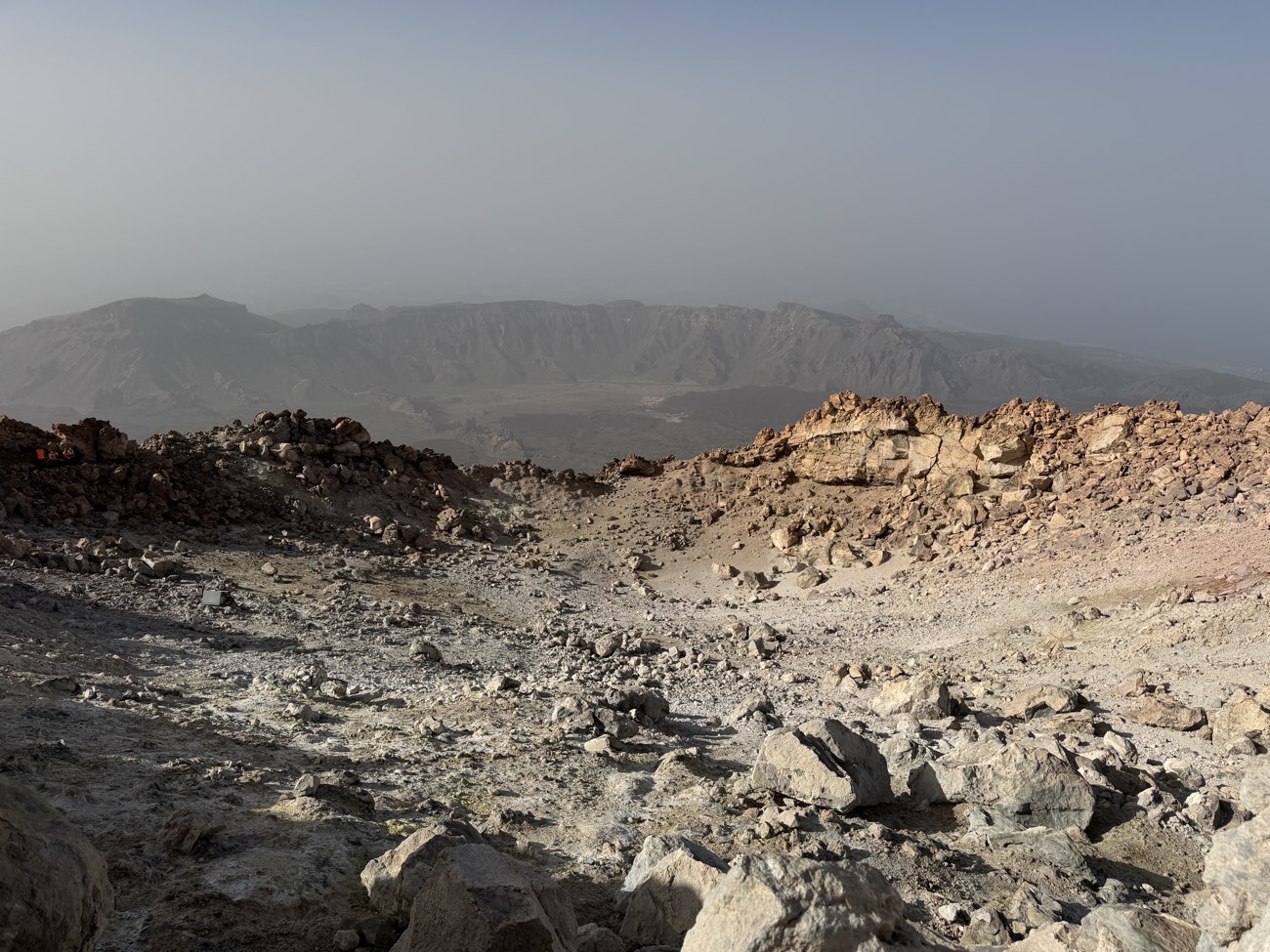
Montaña Blanca sits on Teide’s eastern flank, inside the great bowl of the Las Cañadas caldera, a depression roughly 16 km by 10 km. The national park around it was created in 1954 and inscribed as a UNESCO World Heritage site in 2007. From the caldera floor the cone is unmistakable: a pale heap of pumice rising to about 2,750 m, set against the dark lavas of the slopes above and around it. The eye picks it out easily among the darker rock.
The caldera’s interior includes the Llano de Ucanca, a great sediment plain, and the rock wall of the Roques de García. Montaña Blanca rises on the mountain’s flank above that landscape, and its paleness is what separates it from the darker ridges around it.
The colour is the point. The cone is built of pumice, lava that was foamed by expanding gas and then froze with its bubbles trapped. Pumice is light and frothy, and it stands out sharply against the darker rock of Teide’s flank. The name Montaña Blanca, white mountain, is a description rather than a title.
Teide’s own name is usually traced to the Guanche Echeyde, though competing derivations exist. The Guanches, the island’s pre-conquest inhabitants, treated the high ground with ritual restriction, and Echeyde carried an association with the underworld. Montaña Blanca’s name is Spanish and says exactly what it means. The cone is also young in volcanic terms. Roughly 2,000 years old, it is a recent addition to an island whose oldest subaerial rocks date to around 12 million years ago.
An eruption that threw rather than flowed
The eruption that built Montaña Blanca was explosive rather than effusive. Instead of pouring out a lava flow, it threw out fragments of molten rock, and those fragments piled up around the vent to form the cone. The pumice that gives the mountain its colour is the signature of that style of eruption.
When gas-rich magma rises, the gas expands as pressure drops. If it cannot escape steadily, the expansion shreds the magma into fragments, and the fragments cool quickly with their gas bubbles still trapped. The result is pumice: light, frothy rock, pale enough in this case to be read from a distance. An effusive eruption, by contrast, lets gas escape more easily and pours out lava that flows downhill. Montaña Blanca’s slopes are covered in the pale material the explosion produced, rather than in a dark flow.
A cone built this way grows around the vent, each explosion adding a layer of fragments. The result is a mound whose shape reflects the slope it formed on.
The difference between the two styles is not a matter of violence alone. It depends on how much gas is in the magma and how easily that gas can get out. The island’s volcanism has produced both styles at different times, which is one reason its record contains such different events.
The eruption happened roughly 2,000 years ago, before the written record on Tenerife, which begins with the island’s conquest in 1494–1496. The cone is younger than the main Teide edifice it sits on, and older than the historical eruptions of the last three centuries. Its story is written in the pumice itself, and in the odd objects scattered on its slopes.
Los Huevos del Teide
Among the pumice on the cone’s slopes lie the objects known as Los Huevos del Teide, the eggs of Teide. They are accretionary lava balls: rounded lumps formed when pieces of still-plastic lava broke loose and rolled downhill, gathering material as they went.
The process is something like a snowball. A sticky lump of cooling lava moves down the slope, and each revolution picks up more of the loose material around it, growing rounder as it travels. The result is a scattered collection of stone spheres that look, to a casual eye, like eggs left on the mountainside.
The term “accretionary” describes exactly that: growth by accumulation. The lump must have been plastic enough to pick up new material, yet coherent enough not to fall apart while rolling. That combination does not last long once the lava begins to cool, so the eggs record a narrow window of conditions during the eruption.
The eggs are one of the national park’s most distinctive small features, and they lie on Montaña Blanca itself, among the pale pumice of the eruption. What is striking about them is the process they record: a brief moment of rolling and gathering on a slope that has otherwise been still for two millennia.
A young cone in an old volcanic story
Montaña Blanca’s eruption lies outside the written record, which on Tenerife begins with the conquest of 1494–1496, the last Canary island to fall to Castile. The eruptions that do appear in the record are listed below. They are the island’s recent volcanic history, and the context for the older cone.
| Eruption | Date | Notes |
|---|---|---|
| Siete Fuentes, Fasnia and Arafo | December 1704 to March 1705 | Three vents in three months |
| Trevejo / Montaña Negra | May 1706 | Lava buried the port of Garachico |
| Narices del Teide (Chahorra) | June to September 1798 | Longest historical eruption on Tenerife |
| Chinyero | November 1909 | Most recent eruption on Tenerife |
Montaña Blanca is older than every eruption in the table. Its own eruption was explosive, and it left pumice rather than a flow; the 1706 eruption, by contrast, buried Garachico in lava. The record shows Tenerife’s volcanism capable of both styles. It is also an incomplete record: a volcanic island’s written history depends on who was watching and writing, and the list above covers only the last five centuries.
Three vents in three months, as in 1704–1705, shows how complex even a single episode could be. The 1909 eruption at Chinyero lasted about ten days, a brief event by comparison with the three months of 1798.
The 1798 eruption, the longest in the island’s historical record, broke out on the flank of Pico Viejo, the 3,135 m neighbour of Teide whose crater is roughly 800 m across. Alexander von Humboldt climbed Teide in June 1799, less than a year after that eruption had ended. The island’s volcanism was not ancient history even then.
The cone’s own age, roughly 2,000 years, is a geological estimate and should be read as an approximation. It had no witnesses, and no written account of it survives, because the island’s written record begins centuries later. What survives is the landform itself.
The track across the cone
The most common way to see Montaña Blanca is to walk across it. Trail 7, the standard walking ascent of Teide, climbs the cone’s flank in a broad, pale zigzag with no shade, then continues to the Altavista refuge at 3,260 m. The route is exposed, and the surface underfoot is the pumice of the eruption itself.
The eggs lie on the cone’s slopes, and walkers on the track pass among them without necessarily noticing what they are. The cone here is not a viewpoint or a destination; it is the ground the route crosses. Its paleness is what makes the zigzag visible from below, a pale thread drawn across the mountain’s dark flank. For the practical details of the ascent, see the Teide hiking guide.
A landform still being read
Montaña Blanca is not a dead feature of a dead mountain. Teide is active but not currently erupting, dormant rather than extinct, and the island’s volcanic system is monitored by INVOLCAN and IGN using seismometers, GPS and GNSS deformation measurements, and volcanic-gas analysis.
In 2004, an anomalous seismic swarm, a cluster of small earthquakes in a short period, raised concern across the island. It became known as the 2004 seismic crisis. No eruption followed, but the episode showed why the monitoring exists. No one can say when the next eruption will come; the instruments are there to watch, not to predict dates.
The cone’s pumice is part of that story. A deposit like Montaña Blanca records an eruption style, explosive rather than effusive, and deposits like it are what geologists study to understand what a volcano has done in the past. The cone’s age gives that study a scale: explosive eruptions are part of this volcano’s recent past, not only its ancient history. The pale colour that gives the mountain its name is the same thing that tells the story: gas, trapped in the magma, expanded until the rock shattered and froze into froth. Two thousand years later, the cone still reads clearly.