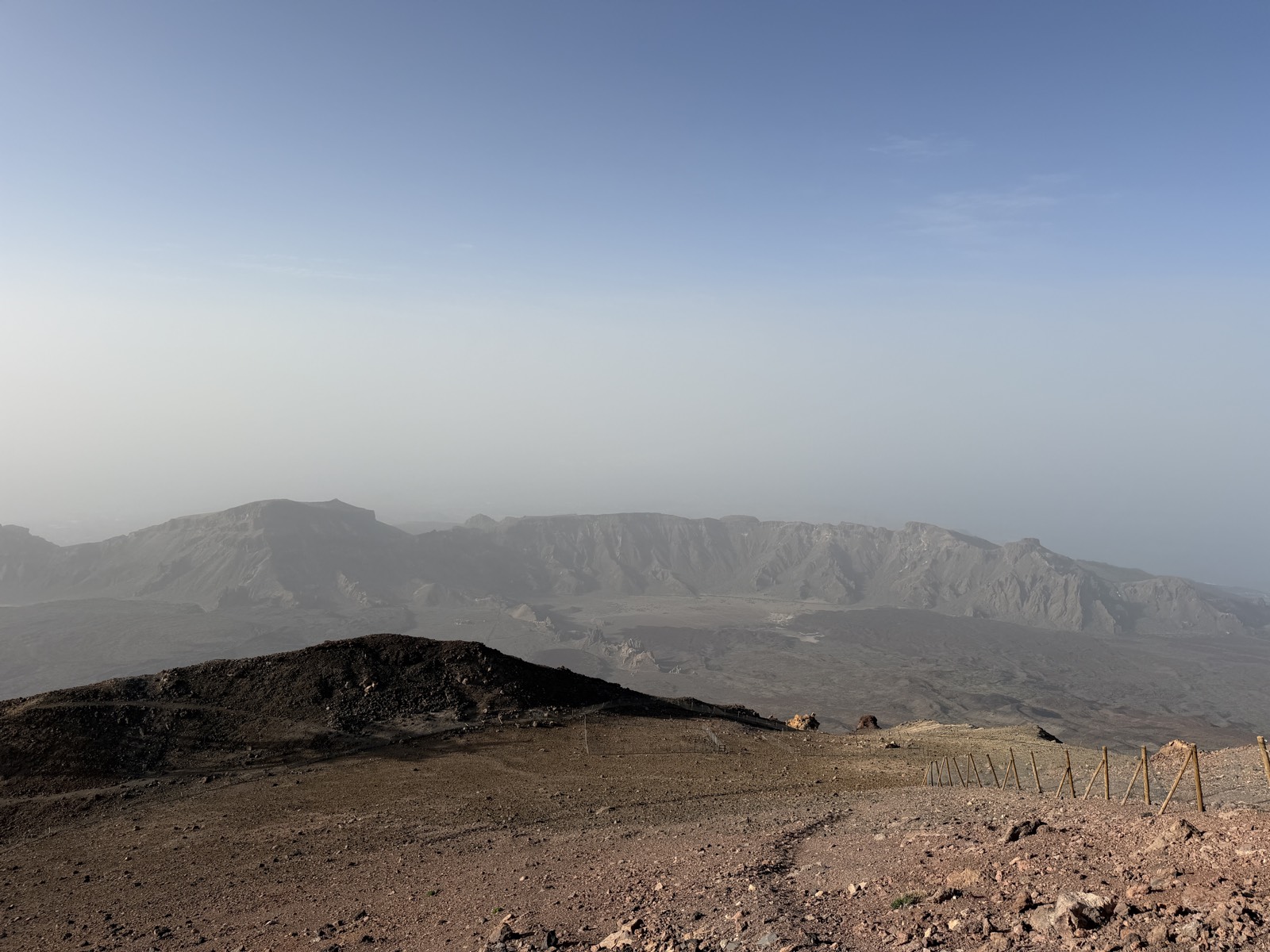
Eruption history
Is Mount Teide Still Active?
A visitor standing at the summit of Mount Teide, looking down into the pale, sulphur-stained crater, will notice a faint, acrid smell. That smell is the first and simplest answer to the question. The mountain is not a cold relic. Gas is still moving through its plumbing. The question is not whether Teide is alive, but what kind of life it is leading, and how we would know if that were about to change.
Active, dormant, extinct — what the terms actually mean
Volcanology uses three words to classify a volcano’s state, and they are often muddled in everyday use. The distinctions matter, especially on an island where a large population lives within sight of the summit.
An active volcano is one that has erupted during the Holocene (the current geological epoch) and retains a magma system capable of producing another eruption. The definition is geological, not journalistic. It says nothing about what the volcano did last Tuesday. It says the system is still connected to a source of melt and has shown it can reach the surface within a timespan that, in geological terms, is recent.
A dormant volcano is active but not currently erupting. It is sleeping, not dead. The magma system is still there, and the volcano is expected to erupt again at some point in the future. Most of the world’s active volcanoes are dormant most of the time.
An extinct volcano is one with no reasonable prospect of future eruption. The magma supply has been cut off, the plumbing has cooled and solidified, and the volcano is a fossil of its former self.
Teide is unambiguously active and, at present, dormant. It has erupted well within the Holocene. Its summit still vents gas. The monitoring networks that watch it are not there out of academic curiosity — they are there because the volcano is considered capable of erupting again.
The last eruptions of Teide itself
When people ask whether Teide is still active, they often mean the central cone that dominates the skyline. That cone, the stratovolcano that gives the park its name, last produced eruptive activity in 1798. The eruption did not come from the summit crater. It opened on the western flank of Pico Viejo, the older, broader volcanic edifice that shares the same magmatic system and sits immediately adjacent to Teide proper.
The 1798 event is known as the Narices del Teide eruption, or Chahorra. It lasted roughly three months, from June to September. It was an effusive flank eruption (lava flows rather than a violent explosive column) and it built the dark, jagged field of lava still visible today on the slope below Pico Viejo. No one died, and the flows did not reach populated areas, but the event was well documented and left a clear geological signature.
The summit crater of Teide itself has not produced a significant eruption in recorded history. Its most recent activity at the top is far older than 1798. The fumaroles there are not the prelude to an imminent summit eruption. They are the normal exhalation of a cooling but still-connected magmatic system at depth.
Tenerife’s most recent eruption — Chinyero, 1909
The most recent volcanic eruption anywhere on Tenerife occurred in November 1909 at Chinyero, a vent roughly 10 km northwest of Teide’s summit. The eruption lasted about ten days and produced a modest lava flow that stopped short of settled areas. It was a small, well-behaved event by volcanic standards, but it is the reason the island’s volcanic system is considered historically active.
The gap between 1909 and the present is, in geological terms, trivial. Many volcanoes have repose periods measured in centuries or millennia. A silence of a little over a century does not make a volcano extinct. It makes it quiet.
The Chinyero eruption is also a reminder that future activity on Tenerife need not come from Teide’s summit cone. The island’s volcanism is distributed across a rift system. The next eruption could open anywhere along the northwest or northeast rift zones, or within the caldera itself. The central cone is the most visible part of the system, but it is not the only part.
What the summit tells you right now
The most direct evidence that Teide remains active is accessible to anyone who walks the final section of trail to the summit. The crater releases fumarolic gases (predominantly water vapour, carbon dioxide and sulphur dioxide) through vents in the crater walls and floor. The sulphur smell is unmistakable, and on cold mornings the steam is visible.
Fumaroles are not a sign of impending eruption. They are a sign that hot rock exists at relatively shallow depth, and that gas is percolating upward through fractures. The summit area is warm enough that snow melts faster around the vents, creating odd, patchy patterns in winter. The Cueva del Hielo, a lava tube below the summit, holds ice year-round despite the heat above — a small, strange equilibrium inside a mountain that is both hot and cold at once.
These surface expressions are the passive, continuous output of a magmatic system that is cooling but not yet cold. They would be present even if the next eruption were centuries away. Their significance is not that they signal danger, but that they confirm the system is still connected to its heat source.
The 2004 seismic crisis
In 2004, Tenerife experienced a swarm of small earthquakes that caught the attention of both scientists and the public. The epicentres clustered beneath the island, and the pattern was not typical of the background seismicity that the monitoring networks had recorded before. The number of events, their depth and their migration over time suggested the movement of fluids (possibly magma) at depth.
No eruption followed. The swarm subsided, and the island returned to its background state. But the episode had consequences. It exposed gaps in the monitoring coverage at the time, and it led directly to a strengthening of the observation networks operated by INVOLCAN (the Canary Islands Volcanological Institute) and the IGN (Spain’s National Geographic Institute).
The 2004 crisis is now the reference point for discussions of volcanic risk on Tenerife. It demonstrated that the system can show signs of unrest without proceeding to an eruption, and it underlined the value of having instruments in place before, not after, a swarm begins. It is also a reminder that the question “is Teide still active?” is not settled by looking at the last eruption date alone. Activity includes the quiet signals — the seismicity, the deformation, the gas — that occur between eruptions.
How the volcano is monitored
Teide is one of the most intensively watched volcanoes in Europe. The monitoring effort is a layered collaboration between INVOLCAN and the IGN, with additional input from university and international research groups. The instruments are distributed across the island and concentrated around the central edifice. They work together in three main streams:
| Instrument | What it measures | What it reveals |
|---|---|---|
| Seismometers | Tiny earthquakes, most too faint to feel | Movement of magma or adjustment of the volcanic edifice; depth, frequency and migration patterns |
| GPS and GNSS stations | Ground deformation down to centimetre scale | Pressure changes from magma accumulating at shallow depth (surface swelling) |
| Gas analysers | Composition and flux of summit fumarole gases | Influx of fresh magma; changes in sulphur dioxide or gas ratios |
The data from all three streams — seismic, deformation and gas — are integrated in real time. The system is designed not to predict eruptions with a date, which volcanology cannot reliably do, but to detect the patterns of unrest that have preceded eruptions at similar volcanoes elsewhere.
Why this matters on an island
Teide sits inside a national park, but the park sits inside an island with a permanent population of hundreds of thousands and a transient tourist population that can double that number in high season. The volcano is not remote. The cable car carries visitors to the upper station at 3,555 m, a short distance below the summit. The caldera floor is crossed by roads. The nearest towns lie within a few kilometres of the central cone.
This proximity is why the monitoring exists at the level it does. The investment in instrumentation and scientific staffing is a direct response to the combination of an active volcanic system and a large exposed population. The same calculus applies at Vesuvius, at Etna, at Popocatépetl. Teide is in that company.
The park’s status as a UNESCO World Heritage site and one of the most visited national parks in Spain adds another layer of attention. An eruption would not only be a geological event. It would be an economic and logistical crisis. The monitoring networks are, in part, an insurance policy against that scenario — not because they can prevent an eruption, but because they can provide the early warning that makes a managed response possible.
The gap since 1909 — what it means and what it doesn’t
A common reaction to the fact that Tenerife has not erupted since 1909 is to assume the volcano is winding down. The opposite could be true. Many volcanic systems accumulate magma over long periods and release it in bursts separated by centuries of quiet. The current silence is well within the normal range of repose periods for stratovolcanoes in similar tectonic settings.
The geological record of Teide and its predecessors shows a pattern of large, explosive eruptions separated by long intervals, interspersed with smaller effusive events like Chinyero. The system has produced catastrophic flank collapses in the distant past. The most recent, roughly 180,000 years ago, removed the island’s north flank and created the Icod valley. It has also produced long-lasting effusive eruptions like the 1798 event. The range of possible future behaviour is wide, and the historical record is too short to constrain it tightly.
What the gap since 1909 does not mean is that the system has shut down. The fumaroles, the seismicity and the deformation data all indicate otherwise. The volcano is in a period of repose, not retirement.
What would unrest look like
If Teide were to reawaken, the first signs would probably be seismic. A swarm of small earthquakes, similar to 2004 but more intense or more persistent, would likely be the earliest detectable signal. Ground deformation would follow if magma began to accumulate at shallow depth. Gas emissions would change in composition and volume.
The progression from initial unrest to eruption is not inevitable. Many swarms subside without producing an eruption, as the 2004 crisis did. The monitoring networks are designed to distinguish between the two scenarios, but the distinction is probabilistic, not certain. The scientists who watch the data are looking for patterns that match the precursors seen at other volcanoes, and they are doing so in real time, with the understanding that every volcano is different.
The alert-level system used by the authorities translates the scientific data into operational categories. It is the mechanism by which a change in the volcano’s behaviour would be communicated to the public and to the agencies responsible for civil protection.
The key point is that an awakening would not come without warning. The monitoring infrastructure is dense enough, and the lead times long enough, that a sudden, unheralded eruption is extremely unlikely. The risk is not zero, but it is managed.
The Guanche layer — a different kind of knowledge
The original inhabitants of Tenerife, the Guanches, did not need seismometers to know the mountain was alive. Their mythology placed a malign spirit, Guayota, inside Teide. The supreme god Achamán defeated Guayota and sealed him in the mountain, and the pale summit — the plug of light-coloured rock that caps the cone — was explained as the seal itself. The Guanche name for the mountain, Echeyde, is usually understood as the origin of the modern name Teide, though competing etymologies exist.
The myth is not a geological account, but it encodes a recognition that the mountain was dangerous and potent. The Guanches imposed ritual limits on access to the high ground. They understood the volcano as a place of power that required caution. That understanding, stripped of its supernatural framing, is not far from the modern scientific view. The mountain is active. It demands respect. It is watched.
Visiting an active volcano
The practical reality of visiting Teide is that the volcano’s active status imposes very few restrictions on the visitor. The national park is open, the trails are maintained, and the cable car runs daily. The summit permit system exists to protect the fragile crater environment, not to manage volcanic risk. The monitoring networks operate in the background, invisible to the public.
The most tangible connection between the volcano’s activity and the visitor experience is the sulphur smell at the summit. It is a small, sensory reminder that the mountain is not a monument. It is a functioning geological system, and the heat that drives it is still there, a few kilometres down.
For those who want to understand the volcano beyond the view, the visitor centres at El Portillo and in the park offer exhibits on the geology and monitoring of Teide. The observatory at Izaña, run by the Instituto de Astrofísica de Canarias, is not generally open to the public, but its presence on the ridge above the caldera is another reminder that Teide’s high, dry, stable atmosphere is a product of its volcanic geography. The mountain is active in more ways than one.
For practical information on access, facilities and the rules that govern a visit, the Teide National Park guide covers the essentials.
The mountain’s long future
Teide will erupt again. That statement is not a prediction. It carries no date, no probability, no scenario. It is simply the logical consequence of the evidence. The system is active. Active systems erupt. The interval since 1909 is a blink in geological time, and the forces that built the mountain — the slow upwelling of magma from the mantle, the accumulation of melt in crustal reservoirs, the eventual release of pressure at the surface — are still operating.
What cannot be said is when, or where on the island, or at what scale. The next eruption could be another Chinyero — small, brief, locally disruptive. It could be a repeat of the 1798 flank eruption. It could be something larger, on a timescale that extends beyond the historical record. The geological past of Tenerife includes events far more violent than anything in the last five centuries, and those events remain part of the volcano’s repertoire.
The monitoring networks exist because that uncertainty is real. They do not eliminate it, but they reduce it to a manageable risk. The mountain is watched, and it will continue to be watched, because the question “is Teide still active?” has only one honest answer. Yes. It is sleeping, not dead. The smell at the summit is the proof.